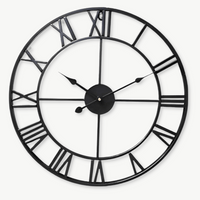


There's a moment when you hang a new clock and step back to look at it. Sometimes it fits. Sometimes it fights everything around it. Numbers, tick marks, roman numerals, bold fonts, they can turn a simple timekeeper into something that shouts. A contemporary wall clock with no numbers does the opposite. It holds time quietly, like punctuation that doesn't need to be read to do its job.
That might sound counterintuitive. Isn't the whole point to tell the time? Yes, and a well-designed numberless dial does exactly that, because your eye already knows where 12 is. What changes is everything else: the visual weight on your wall, the mood in the room, the way the clock contributes to a space rather than competing with it.
À retenir
- Numberless dials reduce visual clutter without sacrificing legibility, your brain fills in the positions automatically.
- A clean dial works hardest in rooms where the wall itself is a design statement (gallery walls, textured plaster, bold paint).
- Material and scale matter more on a numberless clock than on a traditional one, the face has nowhere to hide.
- Silent quartz movements are the standard expectation in this category; ticking is the one noise a quiet room can't absorb.
- The best placement pairing: a contemporary wall clock with no numbers above a console or floating shelf, where the hands become a kind of kinetic sculpture.
Why Numbers Became Optional in Modern Clock Design
Clock faces with printed numerals go back centuries, when readable dials were a practical necessity in low-light homes and public spaces. The numbers were functional infrastructure. Fast-forward to 2026, and most of us check the time on a phone first. The wall clock has shifted roles. It's less utility, more presence.
That shift opened the door for designers to strip the dial back. Scandinavian studios were among the first to treat the clock face as negative space, a discipline borrowed from furniture design, where absence of ornamentation is itself the aesthetic decision. German Bauhaus principles followed the same logic: remove anything that doesn't serve the function, and what remains becomes beautiful precisely because of its restraint.
The result is a category of modern wall clocks where the hands do all the talking. Slim brass hands on a matte white face. A single brushed steel ring at 50 cm diameter, hands only. An acrylic disc so thin it seems to float. These pieces don't read as clocks at first glance, they read as art. Then you notice the hands moving, and there's a small, satisfying surprise. That's the magic of a well-executed contemporary wall clock with no numbers: the functional reveal feels almost theatrical.

Did you know?
The Braun clock series designed by Dietrich Lubs in the 1980s, famously without numerals and with a minimalist face, is widely credited as one of the most influential product designs of the 20th century. It directly inspired the clock app icon on the original iPhone, which Apple designer Jony Ive has acknowledged publicly.
The Rooms Where a Numberless Dial Really Works
Not every space is a candidate. A clock with no numbers on a busy, pattern-heavy wallpaper can look like an afterthought. But in the right context, it's exactly the anchor a room needs.
Open-plan living spaces
These rooms carry a lot of visual information already: furniture arrangements, light sources, the transition between kitchen and lounge. A bare, graphic dial reads cleanly across distance. You get the time at a glance from the sofa without a cluttered numeral-ring pulling at your eye. Large formats, 40 cm and above, work best here; they hold their own against high ceilings and wide walls.
Minimalist bedrooms
This is probably the strongest use case. A bedroom built around calm, neutral linen, low bed frame, a single reading lamp, needs a clock that doesn't spike the visual heart rate. A small to medium minimalist wall clock in wood or soft metal feels like it grew out of the wall rather than being pinned to it. The hands move, time passes, and the room stays quiet. If your bedroom palette runs toward warm oatmeal tones and tactile oak, a bamboo or light-ash numberless dial will feel like it belonged there all along.
Home offices with a Scandinavian or Japanese aesthetic
Both of these design traditions, *Scandinavian* and *wabi-sabi* Japanese, place high value on purposeful objects. A clock that carries no extra information beyond the time fits that philosophy without compromise. Pair it with a Scandinavian wall clock aesthetic, light oak, black hands, no second hand, and it holds the room together rather than decorating it.
Entryways and hallways
Narrow walls, transient spaces, glancing light. A numberless face in a metallic finish catches that light and becomes sculptural. You don't need to stand in front of it to tell the time; you read it peripherally as you pass.

Materials That Define a No-Numbers Clock
On a traditional dial, the numerals do a lot of decorative work. Remove them, and the material becomes the design. This is where your choice of finish actually matters more than on any other clock type.
Metal: the most versatile choice
Brushed steel, powder-coated iron, and raw aluminium are all strong options for a minimalist wall clock with no numerals. Metal dials hold geometric shapes well, think ring frames, open-spoke designs, or the simple pressed-circle that's become a shorthand for contemporary style. They suit industrial kitchens, loft apartments, and any space that already uses metal in its fixtures or furniture. If your kitchen has a matte-black tap and stainless appliances, a powder-coated iron dial ties that thread together without feeling forced.
Wood and bamboo: warmth without nostalgia
A wooden numberless dial avoids the cottage-clock associations of painted numerals. Without the numbers, you're left with the grain, the edge profile, and the color of the material itself. Lighter bamboo reads Scandinavian. Darker walnut reads mid-century. Either way, the absence of text keeps it from sliding into retro territory. For a bedroom or living space built around natural textures, this is often the most harmonious option.
Acrylic and glass: the invisible clock
Transparent and semi-transparent dials create a floating-hand effect that's particularly striking on textured or colored walls. The clock marks the wall without masking it. It's a smart choice for wallpapered rooms or spaces where you've invested in the surface itself, exposed brick, limewash plaster, hand-painted murals. The face disappears; the hands remain. This is the finish that generates the most "wait, is that a clock?" reactions from guests, which is either a bonus or a reason to reconsider, depending on your priorities.
How to Size a Numberless Clock Correctly
Standard sizing advice applies here, but there's a specific twist with numberless dials: they read smaller than clocks of the same diameter that carry numerals. The numbers on a traditional face add visual density and apparent size. Strip them away, and a 30 cm clock can feel like a 25 cm clock at the same viewing distance.
The practical implication: go one size up from what you'd normally choose. If you'd typically hang a 30 cm clock in your bedroom, a 35 or 40 cm numberless dial will feel proportionally equivalent. For a living room wall that's 3 meters or wider, a minimum of 50 cm is worth considering, anything smaller risks looking tentative rather than intentional.
| Room Type | Recommended Size (numbered) | Recommended Size (no numbers) |
|---|---|---|
| Bedroom | 25-30 cm | 30-40 cm |
| Living room | 40-50 cm | 50-60 cm |
| Hallway / entryway | 25-35 cm | 35-45 cm |
| Home office | 25-30 cm | 30-40 cm |
| Kitchen / dining | 30-40 cm | 40-50 cm |
Placement Logic: Where the Hands Tell Their Own Story
A numberless clock placed badly is a missed opportunity. Placed well, it does something that a numbered clock rarely manages: it functions as wall art that also happens to be accurate.
The strongest placements share one characteristic, the clock is given room to breathe. A centered position on a bare wall, above a low piece of furniture (console, sideboard, floating shelf), creates a natural focal point. The eye lands on the clock first, reads the time, and then settles comfortably on the space beneath it. This vertical anchoring is classic interior design logic, applied to something that moves.
Gallery walls are trickier. A numbered clock among framed prints can easily look out of place, the typography clashes. A clean, numberless dial integrates far more naturally. Treat it as you would a circular mirror: it adds depth and a different visual register without fighting the artwork around it. For designer wall clock options that work within gallery arrangements, look for thinner profiles and simpler hand shapes.
One placement to reconsider: directly above a television. It works if the screen is off, but once the TV is on, the eye can't comfortably hold two focal points at once. Better to shift the clock 60-80 cm to one side, so it reads in peripheral vision rather than competing head-on. For open industrial-style lofts with exposed concrete, pairing a brushed metal contemporary wall clock with no numbers alongside a raw-steel shelving unit creates cohesion that feels curated without being precious.

Hands, Indices, and the Details That Make the Difference
When there are no numbers, the hands carry the full communicative load of the dial. This makes hand design a genuinely important selection criterion, one that most buyers overlook when comparing options online.
Baton hands (flat, rectangular) are the default in minimalist design. Clean, legible, no ambiguity about where they're pointing. They work in virtually any setting.
Sword or dauphine hands taper to a fine point. They add a touch of elegance and slight vintage register, good for transitional spaces that sit between modern and traditional, or for rooms where you want the clock to feel slightly precious rather than purely functional.
Skeleton hands (open cut-out forms) reduce visual weight further. On a glass or acrylic dial, they near-disappear against the wall, leaving only the tips of the hands readable. This is the most architectural option, but it demands good eyesight and strong ambient light to remain practical.
Index markers are the second decision. Some numberless contemporary wall clocks use small dots, dashes, or notches at hour positions. Others have nothing at all, pure blank face, hands only. The former is easier to read quickly; the latter is more visually striking. If the clock will be read regularly under pressure (morning rush, cooking timers), dots at 12, 3, 6, and 9 are worth having. If it lives in a bedroom or studio where time is less urgent, a completely clean face is a pleasure.
The Sound Question: Why Silent Movement Isn't Negotiable
A ticking clock in a quiet room is a different problem from the design questions above, but it matters just as much to how the piece actually lives in your home. Open-plan spaces, bedrooms, home offices, these are precisely the rooms where a ticking second hand becomes genuinely intrusive after a few days.
Silent quartz movements (also called "sweep" movements) replace the standard step-tick mechanism with a continuous-sweep second hand. The result is near-total silence. The second hand glides rather than jumps. In practice, most people can't hear it at all from more than 50 cm away.
Battery consumption is essentially the same between ticking and silent movements, one AA or AAA battery, 12-18 months of use. The accuracy is also comparable, typically within 15-20 seconds per month for both types. So there's no real trade-off in choosing silent. It's just a better option for the rooms where a minimalist wall clock with no numerals belongs.
"A clock should mark the passage of time, not announce it."
A sentiment repeated, in different forms, by Scandinavian and Japanese designers working in the minimalist tradition
Pairing a Numberless Clock with Your Existing Decor
The clean dial of a contemporary wall clock with no numbers gives it unusual flexibility. It doesn't impose a style the way a starburst clock or a heavily ornamented antique dial does. But that flexibility means your choice of finish needs to do the stylistic work instead.
For rooms with warm, natural tones, linen, terracotta, wood, rattan, a clock in natural bamboo, light oak, or matte sand finishes keeps the palette consistent. The clock reads as part of the room rather than a contrast element. For rooms built on cooler, more graphic contrasts, white walls, black furniture, concrete floors, a black wall clock with no numerals is the direct answer: crisp, intentional, unambiguous.
Gold and brass finishes occupy interesting middle ground. They warm a neutral space without adding organic texture. A 60 cm gold metal ring clock with no numbers on a warm-white wall is a statement without being loud. It's the kind of thing people mention when they visit, "where did you get that?" rather than "oh, nice clock."
What to Check Before You Buy: A Practical Checklist
Good-looking product photos can hide a few things that matter once the clock is on your wall. Here's what's worth verifying before checkout.
- Movement type: confirm it says "silent quartz" or "sweep movement." If it just says "quartz," assume it ticks.
- Hand visibility: on glass or acrylic dials especially, check that the hands contrast sufficiently with the face in the photos. Dark hands on a clear face can wash out at distance.
- Weight and mounting: metal clocks above 50 cm can weigh 1.5-3 kg. A single picture hook on drywall is usually fine, but plaster walls and hollow partition walls may need a proper anchor.
- Battery access: some frameless or ring-design clocks route the battery compartment in awkward positions. Check this in product images, you'll be accessing it every 12-18 months.
- Diameter vs. frame diameter: the quoted size is usually the outer frame diameter, not the visible face diameter. On open-ring designs, these are the same thing. On framed designs, the face can be meaningfully smaller than the quoted size.
- Return and exchange policy: sizing surprises happen even to experienced decorators. A brand that offers easy returns on wall clocks takes the risk out of ordering one size up, which, as covered above, is almost always the right call for a numberless dial.
FAQ
Can you actually read the time on a clock with no numbers?+
Yes, reliably. Your brain has internalized clock positions from years of use, 12 is always at the top, 3 to the right, 6 at the bottom, 9 to the left. A contemporary wall clock with no numbers reads just as fast as a numbered one once you're used to it, typically within a day or two of hanging it.
What size should a no-numbers clock be for a living room?+
For most living rooms, 50 cm is a good minimum for a numberless dial. Because the face carries less visual density than a numbered clock, you want the size to compensate. On a wall wider than 3 meters or in a room with ceilings above 2.7 meters, 60 cm or larger is worth considering.
Are silent quartz movements less accurate than standard quartz?+
No meaningful difference in daily accuracy. Both types use a quartz oscillator running at 32,768 Hz and are accurate to within roughly 15-20 seconds per month under normal temperature conditions. The only difference is the gear train design that drives the second hand, sweep vs. step. Battery life is comparable too.
Does a numberless clock work in a kitchen?+
It depends on how you cook. If you check the clock frequently while timing things precisely, a few index dots at the quarter-hour positions make a meaningful practical difference. A completely bare face is better suited to lower-pressure spaces. Metal finishes are preferable in kitchens, they're easier to wipe down than wood in a high-humidity environment.
What interior styles suit a contemporary clock with no numbers best?+
Minimalism, Scandinavian, *Japandi*, industrial, and modern transitional all work naturally with a bare dial. The fewer the decorative elements in the room overall, the more a numberless clock feels at home. It's a harder fit in maximalist, bohemian, or heavily traditional spaces, though a vintage-inspired ring design can sometimes bridge that gap.
Is a minimalist wall clock with no numbers a good gift?+
It's actually one of the more thoughtful home gifts you can give, precisely because it's design-forward without being polarizing. The absence of numerals keeps it style-neutral enough to work across a wide range of interiors. If you know the recipient leans Scandinavian, minimalist, or industrial, a brushed metal or light-wood dial is a very safe and pleasing choice. Just check the wall space they have available and size up accordingly.