
You've got a blank wall, a clear vision, and about forty dollars to make it happen. The good news? how to pick a wall clock for low budget shoppers is really about being smarter about what actually matters in a timepiece, and what's just brand markup. You don't have to choose between "cheap-looking" and "empty wall."
Plenty of people spend months searching for the right clock, convince themselves they need to save up for something expensive, then end up with a generic round plastic clock from a big-box store that doesn't reflect their space at all. That's the trap. Here's what works instead.
Key takeaways
- Budget wall clocks under $70 can absolutely look high-end when you choose the right style and material
- Silent (sweep) quartz movement is a non-negotiable feature even at the lower price range
- Size matters more than price: an oversized clock at $45 reads as a statement piece; a tiny one at $80 barely registers
- Acrylic, bamboo, and metal are the three materials that deliver the most visual impact per dollar
- Matching your clock's style to one existing element in the room (a frame, a furniture leg, a cushion) makes the whole space feel intentional
What "Budget" Actually Means in the Wall Clock Market
There's a real range here. Under $40, you're working with entry-level options, mostly plastic or thin acrylic, often with a ticking mechanism that will drive you up a wall (literally) by night two. Between $40 and $80 is the sweet spot for affordable wall clocks that don't look affordable. You can find metal dials, silent quartz movements, and design-forward silhouettes in that range. Above $80, you start paying for size, premium materials like solid bamboo or cast resin, and brand positioning.
The single biggest mistake budget shoppers make is filtering by price alone. A $35 clock with a loud tick placed in a bedroom is objectively worse than a $60 clock with a silent sweep movement. The movement type affects your daily life in a very tangible way. That quiet bedroom or home office deserves more thought than the sticker price alone.
It's also worth thinking about longevity as part of the value equation. A well-chosen wall clock picked on a low budget that genuinely fits your space will outlast three impulse purchases that don't. That's not just good budgeting; it's good design thinking. If you're already exploring styles, the full wall clock collection is a useful starting point before you narrow down by material or room.

The One Feature You Should Never Skip: Silent Quartz Movement
Quartz movement is the standard across almost all modern wall clocks at this price point. The key distinction is whether it's a "stepping" movement (that classic tick-tock) or a "sweep" movement (silent, continuous rotation). For bedrooms, offices, or any room where you spend focused time, sweep movement is worth every extra dollar it costs.
Most clocks in the $40-80 range now list this clearly in their product specs. If a listing doesn't mention it, assume it ticks. The silence isn't a luxury feature anymore; it's a baseline expectation for anyone who works from home or has a light sleeper in the house.
Size vs. Price: Why Going Bigger Often Costs Less Per Impact
Here's something counterintuitive: a 12-inch clock on a standard living room wall often disappears. It reads as functional, not decorative. But a 10-inch clock in a narrow kitchen hallway or above a small desk? Perfectly proportioned. Size isn't about bigger-is-better; it's about reading the wall.
A useful rule of thumb: the clock should occupy roughly one-third to one-half of the visual width of the wall section where it hangs. For a 6-foot-wide sofa wall, that means you're aiming for at least 18-24 inches. For a kitchen backsplash nook, a 10-12 inch piece is plenty.
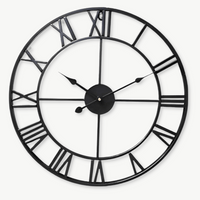
The practical upside for budget shoppers is that larger clocks in simple geometric designs (think flat metal rings or minimalist dials in an industrial or Scandinavian style) tend to cost less per visual square inch than small, intricately detailed pieces. A 20-inch open-ring metal clock can cost $40-60 and fill a wall the way a framed print twice its price would.
| Room Type | Recommended Size | Best Style at Low Budget |
|---|---|---|
| Bedroom | 10-14 in | Silent acrylic or bamboo, minimal dial |
| Kitchen | 10-14 in | Metal dial, bold numbers, easy-read |
| Living Room | 16-24 in | Open-ring or sticker-style, geometric |
| Home Office | 12-16 in | Minimalist, silent sweep, neutral finish |
| Hallway / Entryway | 8-12 in | Vintage or cafe style, character-forward |
Which Materials Actually Look Good Under $80
Material choice is where most budget purchases go wrong. Here's the honest breakdown of what works at lower price points:
- Metal (steel or iron): The best value material for a design-forward look. A flat metal dial in matte black or brushed silver reads as intentional and modern, fitting naturally into industrial or minimalist interiors. It doesn't warp, holds up in kitchens, and photographs well, which matters if you care about your space at all.
- Acrylic: Lightweight, versatile, and available in 3D sticker formats that genuinely create depth on a flat wall. At $39-60, acrylic clocks can pull off a contemporary, gallery-wall look that plastic clocks simply can't touch.
- Bamboo: The material with the highest warmth-per-dollar ratio. Bamboo naturally brings a *wabi-sabi* calm to a room, right at home in Scandinavian or Japanese-inspired interiors. Even thin bamboo veneers (used in lower-budget options) retain the natural grain texture that makes the piece feel organic rather than mass-produced.
- Plastic resin: Avoid unless it's clearly matte-finished and substantial. Shiny plastic ages badly, especially near windows. If the product photo looks glossy, it will look even glossier in person.

Did you know?
Bamboo grows up to 35 times faster than most hardwoods, which is why it tends to cost significantly less than walnut or oak without sacrificing structural quality. A bamboo wall clock at $60 is not a compromise; it's a smart material choice that happens to be eco-friendly as a bonus. Browse the wooden wall clock collection to see what's available in natural grain finishes right now.
Matching Clock Style to Your Existing Interior (Without Redecorating)
You don't need to redesign your whole room to make a budget clock look intentional. The trick is anchoring the clock visually to one element that already exists in the space. Pick a single color, material, or line from something already on the wall or nearby, a picture frame, a shelf edge, a lamp base, and match or complement it with your clock choice.
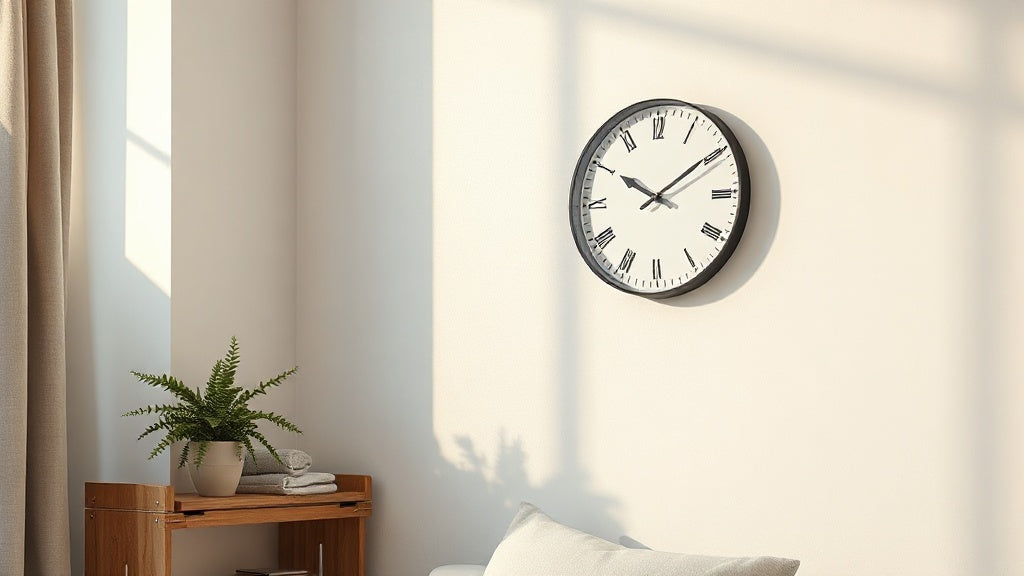
A matte black metal clock above a white shelf with black hairpin legs reads as designed, not accidental. A bamboo-frame clock next to a rattan basket or wooden side table creates a layered natural-materials moment that looks curated. These pairings cost nothing extra; they just require looking at what's already in the room before buying.
For minimalist low-budget wall clock ideas, the sticker-style roman numeral format works particularly well: the clock hands and numerals mount directly to the wall with no casing, which creates a graphic, modern-art effect that reads as deliberately stripped-back rather than cheap. Think of it as the Scandinavian design principle of *less is more* applied to timekeeping.
Elena's pick
Roman Numeral Wall Clock - Sticker Style | 3 Sizes
No casing, no bulk, just hands and Roman numerals flush against your wall, creating a graphic, architectural look for well under $50. If you're going for a minimalist or Scandinavian-influenced interior, this is the anchor piece that pulls it together without blowing the budget.
From $39.00
View product →The Kitchen and Bedroom Rule: Functionality Earns Its Place
In kitchens, readability is the priority. You're checking the clock from across the room with your hands full. That means high contrast (dark numbers on light background, or light on dark), a dial size of at least 10 inches, and ideally bold Arabic or Roman numerals rather than minimalist marker lines. A lot of beautifully designed clocks fail the kitchen test because the hour markers are too subtle to read at a glance. Industrial-style metal dials with bold Arabic numerals are especially strong here: they look intentional against tile or painted brick, and they're built to handle the occasional humidity spike near a stovetop.
In bedrooms, it flips. You don't want a clock that demands to be read; you want one that quietly belongs. Soft color palettes, clean dials, and that silent sweep movement again. The clock should disappear into the room when you're not looking at it, but still be there when you need it at 6am. A matte white or natural bamboo dial in a Scandinavian minimalist style does exactly that.
Elena's pick
Classic Silent Wall Clock - Analog Quartz, 10 in
A clean 10-inch analog dial with silent quartz movement, the kind of understated bedroom clock that works with virtually any interior palette. Put it above your nightstand or dresser and it reads as considered, not convenient.
$50.00
View product →How to Spot a Well-Made Budget Clock Before You Buy
Shopping online for a low-cost wall clock means reading between the lines of product descriptions. A few things to check before clicking "add to cart":
- Weight listed in the specs. Heavier usually means more substantial materials. A 10-inch metal clock under 400g is probably thin stamped steel; over 600g starts to feel like a real piece.
- AA battery (not button cell). Standard AA batteries power the clock longer and are easier to replace. Button cell batteries in a wall clock are a sign of a very thin, underpowered movement.
- Glass or acrylic lens over the dial. Even a thin cover protects the hands from dust and makes the clock look more finished. Many budget clocks skip this; it shows.
- Included hanging hardware. A quality clock ships with a proper wall-mount hook or bracket. If the listing says "no hardware included," you're already starting with a cost and inconvenience addition.
- Customer photos in reviews. Staged product shots can flatter thin materials. Real customer photos in actual rooms tell you whether the finish holds up, whether the size reads as expected, and whether the hands catch light in an annoying way.

Where the Real Deals Hide: Styles That Punch Above Their Price
A few specific design formats consistently over-deliver at lower price points, based on what actually moves off shelves and gets the "exactly what I was looking for" reviews:
3D sticker clocks offer the most visual complexity per dollar. The hands and hour markers mount directly to the wall surface at slightly different depths, creating a dimensional sculptural effect that photographs dramatically and fills a wall the way a framed canvas would. Starting around $39, they're the most honest budget overachiever in the category. The metal markers especially suit industrial loft interiors or any space playing with raw, layered textures.
Small vintage cafe-style clocks work particularly well in kitchens, entryways, and reading nooks. The roman numeral dial, aged frame detail, and compact size (usually 8-10 inches) telegraph "curated" rather than "practical." A good one at $45-55 looks like a flea market find, in the best possible way.
Simple metal kitchen clocks at 30cm nail the industrial-meets-functional brief without any excess. Matte black or brushed silver, bold numbers, and nothing decorative fighting for attention. They read clean and confident.
Elena's pick
3D Sticker Wall Clock - Silent Quartz, Metal, 3 Sizes
Dimensional metal markers that mount directly to your wall. This is the format to reach for when you want maximum visual impact from a budget pick: each marker casts a subtle shadow, adding depth that a standard cased clock simply can't replicate at this price point.
From $39.00
View product →Five Questions to Ask Yourself Before Buying
Budget shopping works best with a short checklist before you commit. These aren't arbitrary rules; they're the questions that separate a wall clock you'll love in three years from one you'll quietly replace next spring.
- Where will it hang, and how far will I read it from? Distance determines the minimum size and dial contrast you need.
- Will anyone sleep near it? If yes, silent sweep movement is mandatory, not optional.
- What's already on that wall or near it? One material or color echo from an existing element is enough to make it look intentional.
- Do I want it to be a focal point or blend in? Focal point means size and personality. Blend-in means clean, minimal, neutral.
- How often will I need to change the battery? Standard AA batteries in a quality quartz movement typically last 12-18 months. If the listing says "button cell," budget for more frequent replacements.
"A clock that fits the room doesn't need to be expensive. It needs to be right."
Elena Rossi, on choosing functional decor with intention
Browsing Smarter: Start with a Curated Wall Clock Collection
If you'd rather browse a filtered selection of well-made wall clocks across styles and price points than comb through thousands of listings, starting with a curated wall clock collection saves time and keeps you from decision fatigue. A good collection is already pre-filtered for quality; you're choosing style, not vetting products from scratch.
For buyers specifically drawn to natural materials and warm finishes, the wooden wall clock collection covers bamboo, oak-veneer, and natural grain options across a wide price range, with several entries well under $80. If the Scandinavian or Japanese aesthetic is your direction, that's the right starting point.
Knowing how to pick a wall clock for low budget really comes down to three things applied consistently: prioritize silent movement, match one visual element already in your room, and choose a size that commands attention rather than disappearing into the wall. Get those three right and the price tag becomes almost irrelevant to anyone who walks in.
Browse the collection
Best Sellers - Clocks
The clocks other buyers keep coming back to, a practical shortcut when you want quality proof before committing to a budget pick.
37 references
Browse best sellers →FAQ
Your questions about budget wall clocks, answered
What is the best material for a wall clock under $70?+
Metal (steel) and bamboo are the two strongest materials at this price point. Metal delivers a sharp, modern look and holds up well near heat or humidity (kitchen, hallway). Bamboo brings warmth and a Scandinavian or natural feel without feeling rustic or cheap. Both age better than plastic and photograph better, which matters when you're choosing something you'll see every day.
Can a cheap wall clock actually be silent?+
Yes, absolutely. Silent quartz (sweep) movements are now standard in many clocks priced $40 and above. The key is knowing what to look for: the product listing should specifically say "silent quartz movement" or "sweep movement." If it only says "quartz movement," assume it ticks. The sweep mechanism eliminates the stepping sound entirely; no compromises needed at this price range if you shop specifically for it.
How do I make a small, budget clock look like a design choice?+
Placement and context do most of the work. Hang it as part of a small gallery wall arrangement where it shares wall space with a framed print or a mirror. Choose a clock that shares one visual element with something already in the room: the frame color, the material, even just the weight of the line. A sticker-style or open-face clock also helps: by having no casing, there's nothing cheap-looking to notice, just the hands and numerals sitting directly on the wall.
What size wall clock should I buy for a living room on a budget?+
For a standard living room, 16 to 24 inches gives you the visual presence to read as a statement rather than a functional object. The good news is that larger clocks in simple geometric formats (open ring, flat metal dial, sticker-style) often cost the same or less than smaller decorative pieces, because they use less complex construction. A 20-inch open-design metal clock at $39-60 fills a sofa wall the way a much pricier framed art piece would.
Is it worth spending $60-80 on a wall clock instead of $20-30?+
For most people, yes, for two specific reasons. First, the $60-80 range reliably includes silent quartz movement, which the $20-30 tier almost never does. Second, materials shift meaningfully: you go from thin plastic to metal, acrylic, or bamboo. Those aren't cosmetic upgrades; they change how the clock reads in the room, how long it lasts, and whether you'll still want it in three years. Think of it as the difference between buying a clock and buying a wall piece that happens to tell time.
How do I know if a wall clock will match my interior style?+
Start with one element already in the room: a picture frame, a furniture finish, a cushion color. If your room leans industrial (exposed brick, metal shelving, dark wood), a matte black steel clock with bold numerals slots right in. If it's Scandinavian (white walls, light oak, clean lines), a minimalist bamboo or white-dial clock keeps the calm. If it's more eclectic, a sticker-style roman numeral clock works across almost any aesthetic because there's so little visual "mass" to clash with what's already there.