
There's something almost hypnotic about watching a pendulum move. That slow, deliberate arc, back and forth, steady and unhurried. It's the opposite of everything rushed about modern life, and maybe that's exactly why vintage wall clocks with a pendulum and antique look are having such a strong moment in home interiors right now.
But here's the thing: most people assume "pendulum clock" means "antique clock," which means either hunting through estate sales or spending serious money on something genuinely old. That's not the full picture. Today's reproduction and heritage-style pendulum wall clocks give you all the visual weight and character of a grandfather-era piece, without the restoration headaches or the three-figure maintenance bills.
So whether you've got a Victorian terrace, a loft conversion, or just a living room wall that desperately needs a focal point, here's what's actually worth knowing.
⭐ Key takeaways
- Pendulum wall clocks with an antique look use visual rhythm, materials, and proportions to create old-world atmosphere in any room.
- Modern reproductions often outperform genuine antiques on reliability, noise levels, and ease of hanging.
- The pendulum length directly affects how fast or slow a clock ticks, which has real consequences for your room's atmosphere.
- Placement matters as much as the clock itself: wall height, surrounding furniture, and light all shape how the piece reads.
- Roman numerals, dark wood cases, brass tones, and aged dial finishes are the four visual cues that most convincingly read as "antique."
What Makes a Pendulum Clock Look Genuinely Antique
Not all pendulum clocks age the same way visually. The ones that convincingly channel a 19th-century grandfather clock share a specific set of design codes, and once you know them, you can spot a well-executed reproduction at a glance.

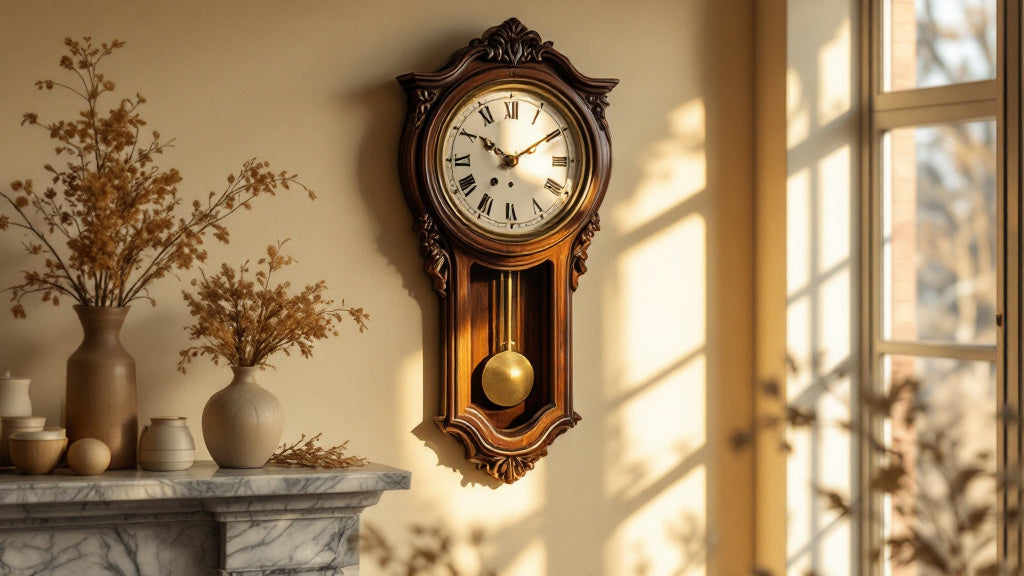
The case shape is the first tell. Authentic antique pendulum wall clocks almost always feature a long, narrow wooden case, sometimes called a "regulator" style, with a visible pendulum window cut into the lower panel. The case wood matters too: dark walnut, mahogany, and ebonized finishes were fashionable from the 1780s through the early 1900s. A pale pine case never quite reads "antique," no matter what else surrounds it.
Then there's the dial. Roman numerals are essentially shorthand for heritage, and they appear on the vast majority of clocks we associate with old European homes. Paired with a warm cream or parchment-toned face, maybe with a subtle aged crackle finish, and the visual effect shifts immediately. Arabic numerals can work in certain styles, particularly German schoolhouse clocks from the early 20th century, but Roman is the safer call if you want that recognizable antique vocabulary.
The pendulum itself deserves more attention than it usually gets. A lenticular brass bob, that classic disc or lens shape, is the most historically accurate. Teardrop-shaped bobs work for certain French-style pieces. The length of the bob and the rod determines the swing speed, and visually, a longer pendulum reads as more formal, more architectural, more "grandfather clock" in character.
Finally: the hands. Spade-shaped or cathedral-style hands in aged brass or black iron complete the look. Thin, modern stick hands break the spell entirely, even on an otherwise beautifully styled case. If you're browsing options, our full pendulum clock collection shows how much these details vary between styles.
💡 Did you know?
The pendulum clock was invented by Dutch physicist Christiaan Huygens in 1656, inspired by Galileo's earlier observations about pendulum motion. Huygens' design reduced timekeeping error from around 15 minutes per day, which was typical for spring-driven clocks of the era, to under 10 seconds. It remained the most accurate timekeeping technology in the world for nearly 300 years.
The Real Difference Between a Genuine Antique and a Heritage Reproduction
Here's a comparison worth making honestly, because it's not one-sided.
| Feature | Genuine Antique | Heritage Reproduction |
|---|---|---|
| Movement reliability | Varies; may need specialist servicing every 3-5 years | Quartz or modern mechanical, low maintenance |
| Noise level | Mechanical tick, often audible across a room | Silent sweep or soft tick depending on model |
| Visual character | Genuine patina, authentic wear, unique history | Consistent finish, sometimes more polished but less "lived-in" |
| Price range | $300 to several thousand for quality pieces | Typically $50 to $400 for well-made options |
| Ease of hanging | Heavy, may require professional mounting | Most under 5 kg, standard wall hook or screw |
| Resale value | Can appreciate with provenance | Decorative value; not an investment |
For most homeowners, the reproduction wins on practicality. But if you're drawn to genuine pieces, the best hunting grounds in 2026 remain specialist antique dealers (London's Pendulum of Mayfair has been a trusted name for decades), architectural salvage markets, and estate auctions. Just budget for a service before you hang it.
Which Room Actually Suits a Pendulum Wall Clock

The instinct is to put a pendulum clock in the living room, and honestly, that instinct is usually right. A pendulum clock needs visual breathing room; it's a piece that draws the eye and holds it. A wall that's already crowded with art, shelving, or a gallery arrangement will swallow it whole.
Here's what tends to work well:
- Living room feature walls: Above a console table or fireplace, centered and given at least 30 cm of clear wall space on either side. The pendulum swing needs visual clearance too.
- Hallways and entryways: A long, narrow regulator-style pendulum clock is practically made for a hallway. It greets guests, sets a tone, and fits proportionally in the vertical space most halls offer.
- Home offices and studies: The rhythmic swing can actually be focusing, not distracting, particularly in a room styled with dark wood furniture, leather, or industrial elements.
- Dining rooms: A statement pendulum clock above a sideboard adds formality and character, particularly in rooms with high ceilings.
Bedrooms are trickier. If the movement makes any audible tick, even a soft one, a sleeping partner will notice at 3 a.m. when the room is silent. Stick to a genuinely silent quartz movement if the bedroom is your plan.
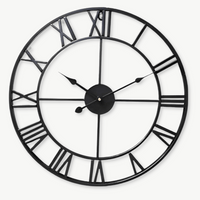
Still not sure which format fits your space? A vintage wall clock with pendulum and antique look reads very differently in a narrow hallway versus a double-height living room. The Vintage Wall Clock with Roman Numeral dial below is a good reference point for scale: its proportions work across both contexts without overwhelming a wall.

Pendulum Styles That Read as "Antique" in a Modern Home
Not every antique-look pendulum clock carries the same aesthetic. There are at least four distinct stylistic traditions, each with a different design language and a different fit for contemporary interiors.
The Regulator Style
Originally precision timekeeping instruments used by watchmakers and railway stations, regulator clocks have a clean, almost architectural quality. Separate subdials for hours and minutes, a weight-driven or quartz pendulum, and a glass-fronted wooden case. They suit minimalist and Japandi interiors surprisingly well because the design is restrained, even though the piece is historically significant. Think: a single walnut-cased clock on a white wall, nothing competing for attention around it.
The Vienna Regulator
A specifically Austrian tradition from the early 19th century, the *Vienna Regulator* features an elegant narrow case, often with slender columns, a porcelain dial, and a long, slender pendulum. The proportions are lighter and more refined than English bracket clocks. They work beautifully in rooms with high ceilings and period plasterwork. If you've got ornate coving or original skirting boards, a Vienna Regulator will feel like it belongs there.
The Black Forest / German Schoolhouse Clock
More rustic and approachable than the Vienna style, these clocks often feature painted dials, turned wooden cases in cherry or oak, and a warm, farmhouse character. They're the natural companion for a kitchen with open shelving, a dining room with a scrubbed pine table, or a converted barn living space. The *Schwarzwälder Uhr* tradition behind these pieces goes back to the 18th century, which gives even a modern reproduction genuine design heritage to draw from.
The French Comtoise (Morbier) Clock
A French tradition from the Franche-Comté region, these clocks feature an exposed pendulum with an ornate brass bob, often in a sunburst or floral design. The movement hangs on the wall without a full case, making the pendulum swing a central visual feature rather than something glimpsed through a window. Dramatic and somewhat theatrical, they suit a French country or eclectic bohemian interior.

How the Pendulum Swing Actually Affects Your Room's Atmosphere
This part doesn't get talked about enough. Most guides focus on how a pendulum clock looks. Fewer address how it feels to live with one.
The pendulum does something subtle but real to a room's atmosphere. That slow, regular motion creates a visual rhythm. It gives the room a kind of pulse. Visitors notice it without always knowing why the space feels different. It's the same principle behind why a fire or a water feature makes a room feel alive: there's something moving, something organic happening.
The swing speed matters more than most buyers realize. A pendulum's period, meaning the time for one full swing, is determined almost entirely by its length. A pendulum of about 99 cm (roughly 39 inches) swings once per second, which is the classic "grandfather clock" tempo. Shorter pendulums, as found in wall-hung reproduction clocks, swing faster and feel more animated, almost playful. Longer pendulums feel slower, more stately, more formal.
If the clock also chimes, that adds another dimension entirely. Westminster chimes on the quarter-hour, a single strike on the hour. Some people find this deeply comforting; others find it intrusive after the first week. Be honest with yourself about which camp you're in before you commit to a chiming model.

Identifying a Vintage Pendulum Clock: What to Check Before You Buy
If you're sourcing a secondhand piece rather than buying new, there are a few things worth verifying that most buyers overlook.
Check the movement type first. An 8-day movement, meaning the clock runs for eight days on a single winding, is the standard for quality wall clocks of the 19th and early 20th centuries. A 30-hour movement is more common in simpler or lower-grade pieces. Both are functional, but 8-day movements generally indicate better original construction.
Look at the pendulum suspension. In good antique clocks, the pendulum hangs from a thin metal spring called a suspension spring. If this spring is broken or corroded, the clock won't keep time properly, and replacement parts can be specific to the maker and era.
The maker's name matters for provenance but not necessarily for quality. German makers like Junghans and Gustav Becker produced enormous quantities of quality wall clocks between 1880 and 1940. French makers like Japy Frères were prolific and reliable. English makers like Enfield produced solid 20th-century pieces. None of these names guarantee condition, but they do point to a mechanical tradition worth understanding.
Finally, listen to it running. A well-regulated pendulum clock has a perfectly even tick-tock, what clockmakers call "in beat." If the tick sounds uneven, like "tick... tock" with unequal spacing, the movement needs adjustment. This is usually a straightforward fix for a clock repairer, but factor in the cost.
"A clock that doesn't run is furniture. A clock that runs is company."
Old clockmaker's saying, origin uncertain
Styling a Pendulum Clock Into Your Existing Interior
The mistake most people make is treating the clock as the last thing they hang, after everything else is already in place. A pendulum clock, particularly a large or ornate one, works better as a starting point, or at least as a key anchor, around which other elements are arranged.
A few approaches that consistently work well:
- The layered mantel: Clock centered above a fireplace, flanked by candlesticks or small plants at different heights. The symmetry suits the clock's formal character without making the arrangement feel stiff.
- The entry anchor: A narrow regulator clock on a hallway wall, with a small console table below it holding a bowl for keys, a candle, or a small plant. The clock gives vertical weight; the table grounds it.
- The mixed-period salon wall: Don't be afraid to put a vintage pendulum clock alongside contemporary art. The contrast reads as intentional and confident rather than confused, as long as the color palette connects the pieces.
- The dark wall moment: A pendulum clock in a dark walnut or ebonized case reads particularly well against a deep-painted wall, forest green, charcoal, navy, or terracotta. The warm brass of the pendulum bob pops against a dark background in a way it simply doesn't against white.
Pendulum Clock
If you're ready to find the pendulum clock that fits your space, this is the place to start, with pieces ranging from compact wall-hung styles to full statement formats.
21 products
Browse the collection →Why the Pendulum Clock Keeps Resonating, Decades After Quartz Took Over
Quartz movements became dominant in the 1970s. They were cheaper, more accurate, and required no winding. By any rational measure, the pendulum clock should have become a museum piece. It didn't.
Part of the answer is aesthetic. A vintage wall clock with pendulum and antique look carries a kind of visual storytelling that a flat dial on a wall simply can't replicate. It has depth, motion, and material warmth. It makes a room feel inhabited rather than decorated.
But part of the answer is also sensory. The slight sound of a mechanical movement. The visible arc of the pendulum. These are things that engage more than just the eyes. In a period when so much of our environment is digitized and frictionless, there's something grounding about an object that keeps time through the law of physics rather than a battery circuit.
That's not nostalgia for nostalgia's sake. It's a genuine response to a genuine quality. The best pendulum clocks, whether genuinely antique or well-made reproductions, bring a kind of presence to a room that very few other objects can. They're worth the thought, the research, and the right wall.
FAQ
What is a wall clock with a pendulum called?+
A wall clock with a pendulum is most commonly called a regulator clock, a longcase wall clock, or simply a pendulum wall clock, depending on its specific style and origin. The term "regulator" historically referred to precision pendulum clocks used as reference timepieces by watchmakers and railway stations. Today, it's used more broadly to describe any wall-mounted clock with a visible swinging pendulum.
How do you identify a vintage wall clock?+
Start by looking for a maker's name or trademark on the dial or movement, often stamped on the backplate. German makers like Junghans and Gustav Becker, French makers like Japy Frères, and English makers like Enfield are well-documented and identifiable. The movement type gives clues about age: platform escapements suggest post-1900, while earlier anchor escapements point to 19th-century construction. The style of the case, dial finish, and hand shape also help narrow down the era and country of origin.
What are some famous pendulum clocks?+
Christiaan Huygens' 1656 pendulum clock, now preserved in the Rijksmuseum in Amsterdam, is arguably the most historically significant. The Shortt-Synchronome free pendulum clock of the 1920s held the world accuracy record for over a decade. In domestic terms, the Vienna Regulator became the defining prestige wall clock of the 19th century, produced in Austria and copied widely across Europe and America. For popular culture, the Black Forest cuckoo clock remains perhaps the most recognized pendulum timepiece globally.
Can a pendulum wall clock work in a modern minimalist home?+
Yes, with the right choice of style. A regulator-style pendulum clock with a clean case, simple dial, and slender proportions can work very naturally in a Japandi or Scandinavian-influenced interior. The key is avoiding overly ornate cases with heavy carved detailing, which tend to clash with minimalist settings. A walnut or matte black case, a plain cream dial, and a simple lenticular brass pendulum bob offer the heritage quality without the visual noise.
Do modern pendulum wall clocks need winding?+
Most modern reproduction pendulum wall clocks use a quartz battery movement to drive the hands, while the pendulum swings decoratively using a separate motor or magnetic mechanism. These require no winding; a standard AA or C battery will run the movement for 12 to 18 months. Genuine antique pendulum clocks with mechanical movements do require winding, typically every 8 days for quality 19th-century pieces, or every 30 hours for simpler models.
Are pendulum wall clocks loud, and can you use them in a bedroom?+
It depends entirely on the movement. A genuine antique pendulum clock with a mechanical escapement produces an audible tick that carries across a quiet room, often around 40-50 decibels close up. Modern reproductions with a silent quartz movement are effectively inaudible; only the pendulum motor produces a faint hum at most. For bedrooms, always choose a model explicitly listed as "silent quartz." For living rooms and hallways, the soft tick of a mechanical movement is part of the appeal for many people.
How much should I expect to spend on a quality pendulum wall clock?+
For a well-made reproduction with genuine wood casing, a quality quartz movement, and brass hardware, expect to spend $80 to $400. Below that threshold, the case materials and finishing tend to suffer noticeably. Genuine antique pendulum wall clocks from reputable makers start around $300 for serviced pieces in fair condition and climb quickly into the thousands for documented examples with original movements in working order. The sweet spot for most homeowners is a mid-range reproduction: real materials, reliable movement, and the heritage aesthetic without the upkeep.