
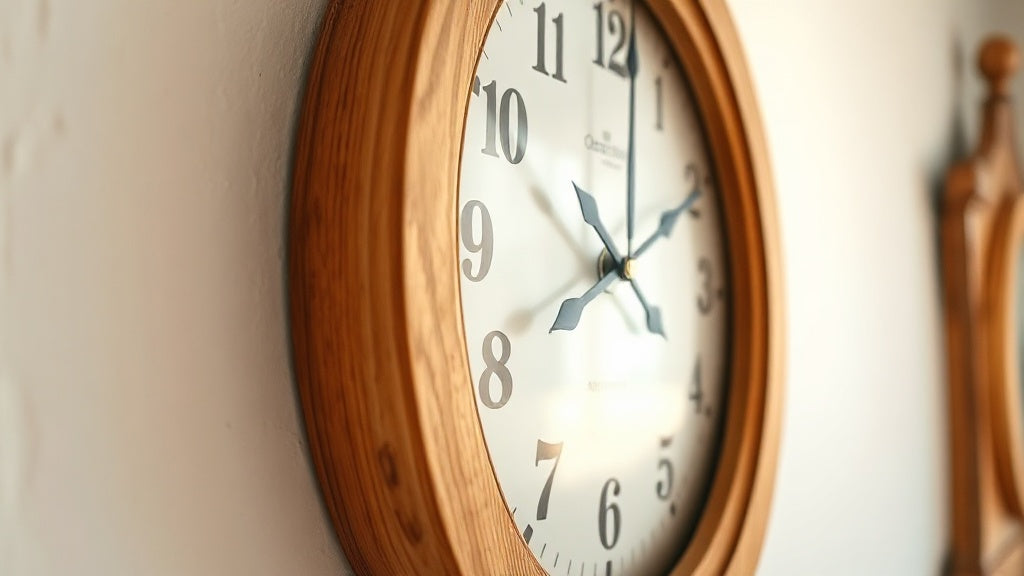
You spot it across the room at a home goods store: a clock with a frame that looks beautifully wooden. Warm tone, visible grain, the kind of piece that instantly reads as considered rather than generic. But then you flip it over, press a fingernail lightly into the edge, and feel that tell-tale hollow softness. It's MDF with a printed wood-pattern wrap. The whole thing was about $30, and now you understand why.
Here's the thing: a wall clock with solid wood frame construction is genuinely different from a lookalike. Not just in how it ages (beautifully, with character), but in how it sounds on the wall, how the grain shifts in different light, and how it holds hardware after years of use. This guide is about helping you tell the difference before you buy, so you don't end up with a print-on-particleboard posing as a heirloom.
À retenir
- Solid wood shows continuous grain through the full thickness of the frame, not just on the surface.
- MDF and particleboard feel noticeably lighter and produce a dull thud when knocked, while solid wood sounds denser.
- Veneer looks real but chips at corners; solid wood frames wear smoothly and can be sanded or refinished.
- Joinery quality (dovetail, mortise-and-tenon) is almost exclusive to genuine solid wood construction.
- Bamboo is a sustainable, high-density alternative that shares many quality traits with traditional hardwoods.
Why "Wooden" Doesn't Always Mean Wood
The word "wood" covers a huge spectrum in the clock market. On one end, you have genuine solid hardwood: oak, walnut, maple, or teak, milled from a single piece or finger-jointed from real timber. On the other end, you have MDF (medium-density fiberboard) wrapped in a photographic wood-grain vinyl, which is essentially a printed photograph of wood glued over compressed sawdust.
In between sits wood veneer, a real wood slice (often 0.5 to 3mm thick) applied over an engineered core. Veneer is honest about what it is, and a well-made veneered clock can look stunning for years. The problem arises when products are marketed using words like "wood finish" or "natural wood look" without specifying the core material. That's where buyers get caught out.
Retailers aren't always lying, exactly. They're just not volunteering the whole story. So you need to ask the right questions, or know where to look. Think of it as three very different products sharing one marketing term: that's the gap this guide is here to close.

The Five Physical Tests That Work Every Time
You don't need specialist knowledge to read a clock frame correctly. You need to know where to look and what you're feeling for. These five checks work whether you're buying in person or evaluating product photos and descriptions online. Once you've run through them a couple of times, they take under a minute total.
1. Check the edges and corners first
Turn the clock around and look at the frame from the side. On a solid wood frame, the grain runs continuously from face to edge with no break in pattern. If you see a thin decorative band on the face and a different-looking, smoother surface on the edge, that's veneer over engineered board. MDF edges are often covered with edge banding or paint because raw MDF looks nothing like wood at all.
At corners, solid wood frames typically show either mitered joints (where grain meets grain at 45 degrees) or more complex joinery. A butt joint with a smear of wood-colored filler? Probably not solid wood.
2. Knock test: listen to the frame
A gentle knuckle knock on a solid wood frame produces a dense, slightly resonant sound. MDF and particleboard sound hollow and flat, almost like cardboard. Veneer over MDF sounds like MDF. This is one of the fastest tests in person and it takes about two seconds. The weight will reinforce your conclusion: solid hardwood is noticeably heavier than engineered alternatives of the same dimensions.
3. Read the grain for consistency
Real wood grain is irregular. It shifts, curves, has knots, has areas of darker heartwood and lighter sapwood. Printed grain on MDF or vinyl-wrapped board is mechanically perfect and repeats itself at regular intervals (look for a pattern that tiles). On a wide frame, you can often see the same grain sequence repeated twice or three times across the face. That's a print, not a tree.
4. Feel the surface texture under good light
Run your fingertip across the frame surface at an angle to the light. Genuine solid wood has micro-texture that follows the grain: tiny ridges and valleys that correspond to hard and soft growth rings. A printed or laminated surface is perfectly flat or has a uniform texture embossed mechanically. Both feel smooth, but one has organic variation and one doesn't.
5. Look at product descriptions with this specific vocabulary in mind
Online, the language used in descriptions gives a lot away. Phrases like "wood effect," "natural finish," "wood-tone," or "wood-style" almost always indicate a non-solid-wood product. Solid wood is a selling point, so genuine manufacturers say it plainly: "solid oak frame," "sustainably sourced walnut," "bamboo construction." If the description is vague about material, ask. A brand confident in its materials answers that question fast.
Did you know?
MDF was developed in the 1960s as an affordable alternative to plywood. It's made by breaking down hardwood or softwood residuals into fine fibers, combining them with wax and resin, and pressing them under high heat. It's genuinely useful in furniture making, but it absorbs moisture and swells over time, which is why solid wood and bamboo frames tend to outlast MDF by a decade or more in normal home conditions.
Solid Wood vs. Veneer vs. MDF: What Actually Changes in Practice
It's worth being concrete here rather than just saying "solid wood is better." The differences show up in specific, practical ways over the life of the piece. And they matter whether you're placing a clock in a minimalist Scandinavian living room or a warmer, more eclectic space where the grain is going to be part of the visual story.
| Criteria | Solid Wood | Veneer over MDF | MDF / Particleboard |
|---|---|---|---|
| Visual aging | Deepens and patinas with time | Stable but chips at edges after years | Print fades; wrap can peel |
| Moisture response | Slight seasonal movement, stable | MDF core swells if exposed | Swells visibly, can warp |
| Hardware grip | Excellent; screws hold for decades | Good initially; loosens with moisture | Screws can strip; pilot holes help |
| Repairability | Sand, oil, or refinish as needed | Limited; veneer damage is hard to fix | Cannot be refinished; replace the piece |
| Weight | Heavier; feels substantial | Medium weight | Often lighter than expected |
| Price range | Higher; justified by longevity | Mid-range | Lowest entry price |

Species Matter: Hardwood vs. Softwood in Clock Frames
Not all solid wood is equal, and the species used in a clock frame affects both its longevity and its aesthetic character. This is the conversation that separates a casual buyer from someone who's going to end up with a piece they're still happy about in fifteen years.
Hardwoods like oak, walnut, cherry, and maple are dense, resistant to denting, and develop beautiful surface patinas over decades. Walnut in particular has a naturally dark, almost chocolate-brown tone that deepens rather than fades with age, making it a natural fit for industrial or mid-century modern interiors where warmth and weight are part of the visual brief. Oak shows strong, straight grain that reads as graphic from a distance, which is exactly why it's a go-to for Scandinavian and minimalist design. These are the species you want in a frame meant to anchor a room for the long term.
Softwoods like pine and paulownia are still genuine solid wood, but they dent more easily and often require a thicker finish to protect them. They're lighter, which makes installation easier, but they won't develop the same density of aging character. Pine can be beautiful in a rustic or farmhouse context; it's less convincing in a refined modern interior where grain detail and surface hardness are expected to do real visual work.
Bamboo, as mentioned, behaves like a medium hardwood in terms of workability and durability. Mango wood, increasingly popular in mid-range home goods, is a genuine hardwood that's a sustainable byproduct of the fruit industry; it has dramatic figuring and a warm golden-brown tone that photographs well and brings an organic quality to both boho and transitional spaces.
The species question also connects directly back to the five tests above. A walnut or oak frame behaves very differently under your fingernail than a pine or paulownia one. Hardwood resists the pressure cleanly. Softwood yields slightly. Both confirm you're dealing with real timber rather than compressed fiber, which is the point.
What Joinery Tells You About Overall Craftsmanship
The way the corners of a frame are joined is probably the single clearest indicator of the overall manufacturing quality. Solid wood allows for real joinery techniques that simply aren't possible with MDF because MDF's compressed-fiber structure strips out under lateral stress: screws torque through it, the glue surface crumbles at cut edges, and corner joints fail within a few years of normal use. It's not an opinion about quality; it's a materials science problem baked into the product from day one.
Dovetail joints, recognizable by their interlocking fan-shaped teeth, are the gold standard for frame corners. They're mechanically strong without relying entirely on adhesive, and they look beautiful when visible (as they often are on the back corners of a frame). Mortise-and-tenon joints work on the same principle: a projecting piece fits precisely into a cut recess, creating a joint that handles stress in multiple directions.
Simpler but still solid options include splined miters (where a thin strip of wood reinforces a 45-degree corner cut) and finger joints (interlocking rectangular cuts that give a large glue surface area). All of these require a material that can be precisely cut and holds its shape. MDF cannot do any of this reliably.
What you don't want to see is a corner held together entirely by a metal L-bracket screwed into the inside face, especially if the frame is thin. That's an engineering response to a material that couldn't make the joint itself. It's also a tell that the frame will eventually loosen; L-brackets transfer all the shear load to two small screw holes rather than distributing it across a full glue face or interlocking tooth pattern.
Reading the Back Panel: The Most Honest Part of Any Clock
Most buyers look at the front face of a clock and call it done. Flip it over. The back panel tells you more in ten seconds than the marketing copy tells you in ten paragraphs, and it's where all the decisions about material integrity (or lack of it) become immediately visible.
On a solid wood frame, the back tends to show the same wood species, either left natural or lightly finished. You'll see grain, maybe some variation in color where the piece was cut from different parts of the timber. The hanging hardware (a D-ring, a keyhole slot, or a sawtooth hanger) is screwed directly into the wood with a clean, tight fit. There's nothing to hide, so nothing is hidden.
On MDF or particleboard frames, the back is usually covered: black paint, a paper liner, or a fabric backing. That covering often exists to hide the grey-brown texture of compressed fiber. If the back is heavily finished in a way that makes it difficult to identify the core material, that's worth noting. It's not always a red flag on its own, but paired with vague product descriptions and marketing photos that only show the styled front face, it completes a pattern worth recognising.
Also check where the clock movement screws into the frame. On solid wood, the movement housing sits in a clean routed recess or is mounted flush with a secure fit. On lower-quality frames, the movement is sometimes hot-glued or loosely fitted, which creates wobble over time and affects the accuracy of the hands. This connects directly to the joinery point above: if the brand didn't invest in proper frame construction, they almost certainly didn't invest in movement mounting either.
In short, the back panel is where the five tests from earlier get confirmed or contradicted. A brand proud of what's inside tends to show it. The ones obscuring it with paint and fabric are usually doing so for a reason.
Bamboo: The Sustainable Alternative Worth Knowing About
Bamboo occupies an interesting position in this conversation. Technically a grass rather than a tree, it has a density comparable to many hardwoods (around 600-700 kg/m³ for compressed bamboo products), exceptional tensile strength, and a growth cycle of three to five years compared to sixty or more for oak. That makes it one of the most genuinely sustainable framing materials available.
A solid bamboo wall clock frame behaves much like hardwood in practice. It's resistant to warping, holds screws well, and develops a natural sheen over time rather than fading. The grain is distinctive: fine, parallel lines that catch light differently than conventional wood. For minimalist and Scandinavian-leaning interiors, it's often a better aesthetic fit than oak or pine because its quieter surface lets the clock's overall form do the talking.
The main thing to verify with bamboo is whether the product uses strand-woven bamboo (the densest, most durable form, where fibers are compressed under high pressure) or simply bamboo veneer over a different substrate. The same checks apply: look at the edges, feel the weight, read the specification. Strand-woven bamboo has a tight, almost stone-like density at the cut edge; thin veneer will show its substrate the moment you look at the side profile.

Pricing as a Quality Signal: What Solid Wood Actually Costs
This isn't about expensive being better. It's about calibration. A genuine solid hardwood clock frame with proper joinery, a quality silent quartz movement, and a real finish costs money to make. The material alone, before labor or finishing, is more expensive than MDF by a significant margin.
A good-quality solid wood wall clock typically starts around $65-100 for a smaller piece (10-12 inches) and rises from there depending on species, size, and movement quality. Clocks marketed as "wooden" at $20-35 are almost certainly MDF or particleboard with a decorative finish. That's not automatically a problem if you know what you're buying. It becomes a problem when you pay for quality you're not getting.
Bamboo clocks often sit in a competitive mid-range because bamboo is faster to grow and process than slow-maturing hardwoods. You can get genuine bamboo construction at a lower price point than comparable oak or walnut without compromising on durability. That's one reason solid wood and bamboo wall clocks have become so popular with buyers who want real materials without the premium hardwood price tag.
At the higher end, look for clocks that combine species clearly in their specifications: "reclaimed oak frame with walnut inlay," for example, or "solid teak with hand-rubbed oil finish." That level of specificity is almost always accurate because it's a genuine differentiator the brand wants you to know about. If a brand has invested in selecting and finishing a beautiful piece of walnut or oak, they're going to tell you; they're not going to bury it in a vague "natural material" description.
Caring for a Solid Wood Clock Frame Once You Have It
One of the underrated pleasures of owning solid wood is that you can maintain it. Unlike MDF or vinyl wrap, a genuine wood frame responds to care and improves with it.
Keep it away from direct sunlight for extended periods. UV light bleaches wood unevenly, which causes patchy discoloration over time. This is less of a concern in rooms with diffused natural light; it matters in south-facing rooms with no shading, where a clock in a fixed position might bleach noticeably on one side within a few years.
Humidity matters more than people expect. Wood expands in humid conditions and contracts when dry. For most homes, this isn't an issue; indoor humidity stays relatively stable. Kitchens and bathrooms are the exception. If you're placing a wooden wall clock in a kitchen, choose a well-sealed piece or opt for bamboo, which is naturally more moisture-resistant than most softwoods.
For cleaning, a barely damp cloth is usually all you need. Avoid silicone-based polishes, which can build up on raw or lightly oiled wood and eventually create a cloudy finish. A small amount of food-grade mineral oil or a dedicated wood conditioning oil, applied every year or two, keeps the frame from drying out and cracking at the edges.
If the frame gets scratched, a walnut kernel rubbed along the scratch fills it visually within minutes, releasing natural oils that blend with the wood. It's not magic, but it genuinely works on minor surface scratches and it's the kind of practical trick that makes solid wood ownership feel like a relationship rather than a purchase.
Where to Browse If You Know What You're Looking For Now
The wooden wall clock collection is a good starting point if you want to filter by material and see genuine construction across different price points, from Scandinavian bamboo pieces to more decorative statement frames. For rooms that need something with a bit more presence, the full wall clock range includes solid wood, metal, and mixed-material options with clear specifications.
If Scandinavian minimalism is your direction, the Scandinavian wall clock collection covers clean-lined frames where the material quality tends to be front and center because the design strips everything else away. There's nowhere to hide in a minimal frame, which is exactly why brands that lean into that aesthetic tend to use better materials.
Buying a wall clock with a solid wood frame is one of those decisions that pays off quietly, over years. The piece looks better as the finish develops. It stays put on the wall. It never looks out of place because real materials don't date the way trends do. That's not a marketing line. It's just what happens when you put something made honestly on your wall and live with it.
FAQ: Solid Wood Clock Frames
How do I tell solid wood from MDF just by looking at a product photo?+
Look at the edges and corners rather than the face. Solid wood shows grain continuity across the full edge thickness. MDF edges are usually covered with paint or edge banding because the raw material looks like grey cardboard. Also check whether the back panel is shown; brands using solid wood tend to show it because the material is a feature, not a liability.
Is bamboo as good as hardwood in a clock frame?+
Yes, particularly strand-woven bamboo, which has a density comparable to many temperate hardwoods (around 600-700 kg/m³). It's moisture-resistant, holds hardware well, and doesn't develop the same warp risk as softwoods. Aesthetically, it has a distinct fine-line grain that suits minimalist and Japanese-influenced interiors especially well. For everyday durability it competes directly with oak; the main difference is character: oak develops a richer surface patina over decades, while bamboo stays more consistent in tone.
Can I hang a solid wood clock in a kitchen or bathroom?+
Kitchens with good ventilation are fine for most sealed solid wood or bamboo frames. Direct steam exposure (above a stove or right next to a kettle station) is a risk for any natural wood. Bathrooms are generally too humid for solid wood unless the piece is fully sealed with marine-grade lacquer. Bamboo handles kitchen humidity better than pine or paulownia.
What price range should I expect for a genuinely solid wood wall clock?+
For a 10-12 inch frame in solid bamboo or softwood with a quality silent quartz movement, expect to start around $65-100. Mid-size hardwood frames (oak, walnut) in the 12-16 inch range typically fall between $100 and $200. Larger statement pieces in premium species can go significantly higher. Below $50 for a "wooden" clock, you're almost certainly looking at MDF or veneer.
How do I maintain a solid wood clock frame to keep it looking good?+
Dust regularly with a dry or very lightly damp cloth. Once or twice a year, apply a thin coat of food-grade mineral oil or dedicated wood conditioner to prevent the surface from drying and cracking. Avoid silicone polishes. Keep it out of prolonged direct sunlight to prevent uneven bleaching. Minor surface scratches on unfinished or oiled wood can be filled by rubbing a raw walnut kernel along the scratch.
Which wood species is best for a clock frame in a Scandinavian or minimalist interior?+
Oak and bamboo both work exceptionally well in Scandinavian and minimalist spaces. Oak has a strong, straight grain that reads as clean and graphic from a distance, which complements the pared-back aesthetic. Bamboo has an even quieter surface (fine parallel lines rather than pronounced growth rings) that feels lighter and more contemporary. Walnut is a better fit for warmer, mid-century modern or industrial interiors where the darker, richer tone adds weight to the space.