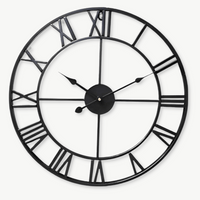


You've been there. You find a clock that looks perfect for your bedroom, the proportions are right, the finish matches your furniture, the price feels fair. You hang it up, get into bed that night, and then you hear it. Tick. Tock. Tick. Tock. Loud enough to keep you staring at the ceiling. The clock is beautiful, but sleeping next to it is another story.
That's the moment most people first start asking: what actually separates a sweep movement wall clock from a standard quartz clock? The short answer is how the second hand moves. The longer answer is that this one mechanical difference changes how a clock sounds, how it feels to live with, and where it works best in your home. Let's dig into what you actually need to know before buying your next piece.
Key takeaways
- A sweep movement wall clock has a second hand that moves in one continuous, silent rotation, with no audible steps.
- Standard quartz clocks use a "step" movement: 60 individual ticks per minute, one per second.
- Sweep movements are the go-to choice for bedrooms, offices, and any room where silence genuinely matters.
- Both types use quartz crystal technology, so timekeeping accuracy is comparable between them.
- The difference is entirely in the motor driver, not the material, size, or price tier of the clock.
How a Standard Quartz "Tick-Tock" Movement Actually Works
Almost every affordable wall clock sold today runs on quartz technology. Inside the movement, a tiny quartz crystal vibrates at exactly 32,768 times per second when an electric current passes through it. A small circuit chip counts those vibrations, divides them down, and converts the result into precisely one pulse per second.
That single pulse per second is sent to a small electromagnetic coil, which steps the second hand forward by one position, holds it for a full second, then fires again. The result is the classic tick-tock you know: 60 audible clicks per minute, each one a discrete mechanical jump. In a quiet room, a standard quartz movement registers around 30 to 40 decibels, roughly the same level as a whispered conversation.
This isn't a flaw, exactly. The step movement has been the industry standard since quartz clocks first appeared in the 1970s. It's reliable, inexpensive to manufacture, and for many people in busy rooms, completely inaudible against background noise. But put one in a bedroom at midnight, and it becomes very noticeable very fast.

What Makes a Sweep Movement Different
A sweep movement wall clock uses the same quartz crystal as a standard clock. The timekeeping accuracy is identical. What changes is how the motor delivers energy to the second hand. Instead of firing one large pulse per second, a sweep motor fires multiple smaller pulses, typically 6 to 8 per second, or in higher-end mechanisms, up to 16 per second. Each pulse moves the hand by just a fraction of a degree.
The practical effect: the second hand appears to glide in one smooth, continuous arc around the dial. No clicking. No stepping. No audible tick. From across a room, a sweep second hand looks almost liquid in its motion, which is part of why it photographs so beautifully and reads as more premium even on mid-range clocks.
The sound reduction is real and measurable. High-quality sweep movements register below 20 decibels, which sits below the threshold of what most people perceive as sound in a normal living environment. That's the difference between "I can hear the clock if I focus" and "I genuinely cannot hear it at all."
Did you know?
The term "sweep" refers specifically to the motion of the second hand, not the overall mechanism. A clock can be labeled "silent" without having a true sweep movement, using instead a low-torque step motor that simply ticks more quietly. Always check whether the product listing specifies "continuous sweep" if silence is non-negotiable for you.
Sweep vs Tick-Tock: A Side-by-Side Look
| Feature | Sweep Movement | Step (Tick-Tock) Movement |
|---|---|---|
| Second hand motion | Continuous, fluid glide | 60 discrete steps per minute |
| Noise level | Below 20 dB (near-silent) | 30-40 dB (audible in quiet rooms) |
| Timekeeping accuracy | Equivalent (quartz crystal) | Equivalent (quartz crystal) |
| Battery life | Slightly shorter (more pulses) | Slightly longer |
| Visual effect | Elegant, premium-looking | Classic, traditional |
| Best rooms | Bedroom, office, nursery, library | Kitchen, hallway, living areas |
| Price point | Slightly higher on average | Widely available at all price tiers |
Which Rooms Actually Need a Sweep Movement?
Honest answer: not every room needs a sweep movement, and paying extra for one in your kitchen or hallway is rarely worth it. The question to ask is how quiet the room gets when no one's talking, no music's playing, no appliances are running.
Bedrooms and nurseries are the strongest case for sweep. When the room drops to near-silence at night, a standard step movement becomes the loudest thing in the space. Parents with light sleepers or babies know this well. A sweep movement silent wall clock removes that variable entirely.

Home offices are the second clear use case. If you work from home and spend time on video calls or focused deep work, a ticking clock sitting in your eyeline can become a surprising source of micro-distraction. The rhythmic sound is regular enough to interrupt concentration in ways that irregular background noise doesn't.
Living rooms and dining rooms sit in the middle. In a room where there's usually some level of ambient noise, a step movement is rarely bothersome. That said, if you're placing a clock in a minimalist Scandinavian living room where the design language is deliberately quiet, a sweep movement fits the aesthetic better too. Silence isn't just acoustic here, it's visual.
Kitchens and hallways are where the tick-tock movement performs fine. Background noise from appliances, foot traffic, and conversation absorbs the sound completely. The mechanical character of an audible tick can even feel charming, particularly with vintage or industrial-style pieces where the sound is part of the personality.
Does Sweep Movement Affect the Style or Materials of a Clock?
This is a question that trips a lot of buyers up. The movement type has nothing to do with the clock's exterior design. A sweep motor can sit inside a bamboo or wooden wall clock, a metal industrial piece, a glass-faced European design, or a Scandinavian minimalist frame. The mechanism is internal and standardized, so manufacturers slot it into any case they choose.
What this means practically: if you find a clock whose design you love, check the product description for the words "sweep," "continuous sweep," or "silent quartz sweep." If the listing just says "silent" without specifying sweep, it may be using a quieter step motor, which is better than a standard step but not equivalent to a true continuous sweep. When in doubt, a quick message to the retailer clarifies it.
Price is a loose but real signal. True sweep movements cost more to produce than step movements, so clocks priced under $30 rarely include one. At the $50-$100 price point, sweep becomes much more common. Above that, it's standard in most quality pieces.
What About Continuous Sweep vs High-Frequency Sweep?
Once you start looking at sweep movements more closely, you'll notice some listings specify "high-frequency sweep" or "ultra-silent sweep." The distinction is real, and it's worth understanding before you decide whether to pay for it.
A standard sweep movement fires around 6 to 8 micro-pulses per second. The hand glides smoothly to the naked eye and the sound is negligible. A high-frequency sweep movement fires 16 or more pulses per second. The motion is even more fluid, essentially indistinguishable from a true mechanical continuous movement at a fraction of the cost.
So when does the difference actually matter? Think about it this way: at normal viewing distance, your eye simply can't register the micro-steps of a standard sweep movement. The hand looks perfectly continuous. But get a macro lens close enough to photograph the second hand in motion and you can capture the individual increments, tiny jumps of roughly 1.5 degrees each with a 6-pulse motor. A high-frequency motor at 16 pulses cuts that to about 0.375 degrees per step, which is genuinely imperceptible even in close-up photography.
In practical living terms, the audio difference between a standard and high-frequency sweep is equally marginal. Both sit comfortably below 20 decibels in a normal room. Neither will disturb a light sleeper. Neither will register on a video call. The gap closes further still when the clock has a solid case, since the housing itself acts as acoustic dampening for whatever micro-vibration the motor produces.
Where high-frequency sweep does justify the price premium is in two specific contexts. First, exhibition and retail display environments, think a beautifully lit clock boutique or a museum installation, where visitors observe the second hand up close and the quality of its motion is part of what they're evaluating. Second, macro-content creation: if you're a photographer or videographer who regularly shoots clock imagery, a high-frequency movement gives you cleaner footage at higher frame rates. For a bedroom, a home office, or a reading corner, a standard sweep movement delivers every benefit you're actually paying for. Save the premium for situations where the visual precision genuinely earns its keep.

Step Movement Has Its Place Too
It's worth saying plainly: a step movement isn't a compromise, it's a different thing. There are rooms and styles where the tick-tock rhythm is actually the right choice.
A vintage kitchen clock with an audible tick connects to a long design tradition. Farmhouse, industrial, and retro interiors often read as more authentic with a clock you can actually hear. The mechanical sound adds a layer of warmth, a sense that the room is alive. Some people actively seek this out, particularly in spaces designed to feel cosy and lived-in rather than pristine.
"A ticking clock is the heartbeat of a home."
A sentiment shared by many designers who work with character-rich, layered interiors
The point is that the step movement isn't a lesser product. It's a different product, one that fits different rooms, different aesthetics, and different preferences. Knowing the difference just means you choose intentionally, rather than ending up with a clock that surprises you at midnight.
How to Read a Product Listing and Spot the Movement Type
Most online clock listings don't make this easy. Here's what to look for and what the language actually means.
- "Silent quartz movement" - could mean sweep or a low-noise step motor. Ask the seller to confirm if it's continuous sweep.
- "Continuous sweep second hand" - the clearest and most accurate description. This is what you want for true silence.
- "Non-ticking" - generally means sweep, but the term is used loosely by some manufacturers.
- "Quartz movement" with no modifier - almost certainly a standard step movement. Assume tick-tock until proven otherwise.
- "High-torque sweep" - a sweep movement designed for larger or heavier hands, common in clocks over 40 cm in diameter.
Battery information can also hint at the movement type. A clock that advertises "up to 2 years on one AA battery" is likely a standard step movement, since sweep motors consume slightly more power. A claim of "12 to 18 months" on a single battery is more typical of a genuine continuous sweep movement.
Pairing the Right Movement with Your Interior Style
Movement choice and style choice don't need to be separate decisions. They map naturally across the most popular interior aesthetics, so let's walk through them.
Scandinavian and minimalist interiors pair best with sweep movements. The silence reinforces the visual calm of the space. Thin metal hands, clean dials, and neutral finishes all read more cohesively when there's no audible click interrupting the quiet. A natural wood wall clock with a sweep motor is almost a default recommendation for this aesthetic.
Industrial and loft-style spaces can go either way. Exposed brick, steel shelving, and reclaimed wood tolerate a ticking clock completely fine. The mechanical sound fits. But if the industrial space doubles as a home office, sweep is still worth prioritizing for focus and call quality. An industrial-style clock with a matte black steel case and a step movement can feel perfectly at home in an open-plan loft kitchen; that same clock in a converted garage studio you use for video recording is a different story. If the space serves double duty, lean sweep.
Vintage and farmhouse styles are the one clear zone where a step movement can actively add character. The tick-tock rhythm belongs in a kitchen with open shelving, ceramic jars, and linen curtains. It feels right. Don't over-silence a room that's designed to have warmth and texture.
Contemporary and art-forward interiors favor sweep, particularly when the clock itself is a design object. If the second hand is part of the visual statement, you want it moving in a way that reads as deliberate and precise, not as a sequence of jumps.
Caring for a Sweep Movement Clock Over Time
Good news: sweep movements are low-maintenance by design. There are no gears to oil, no pendulum to adjust, no winding mechanism to monitor. The main variables are battery quality and the installation environment.
Use alkaline batteries rather than carbon-zinc ones. Carbon-zinc batteries have a higher internal resistance that can cause the motor to underperform slightly, which sometimes manifests as the second hand stuttering or losing time over weeks. A quality alkaline AA battery, replaced annually, is the full maintenance routine for most sweep movement wall clocks.
Temperature and humidity matter more than most people expect. Extreme cold (below 0°C/32°F) slows the battery chemistry and can make even a sweep movement appear to tick unevenly. Prolonged high humidity can affect the motor's internal components over years. For most interior living spaces, neither is a concern. But avoid mounting a sweep movement clock directly above a stove, in an unheated garage, or in a bathroom without good ventilation.
If a sweep movement clock starts stuttering after years of smooth operation, the motor itself has usually reached the end of its service life. Replacement movements are widely available online for $5 to $15, and swapping one out takes about ten minutes with a screwdriver. The clock case, the hands, the dial, all of it stays. Only the motor gets replaced.
FAQ
Is a sweep movement wall clock more accurate than a standard quartz clock?+
No. Both sweep and step movements use the same quartz crystal technology and maintain equivalent accuracy, typically within 15 seconds per month under normal conditions. The movement type affects only the motion of the second hand and the noise level, not the fundamental timekeeping precision.
Can I replace a step movement with a sweep movement in an existing clock?+
Yes, in most cases. Standard quartz movements are interchangeable across many clock frames. You'll need to match the shaft length (the metal post the hands attach to) to your clock's dial thickness, which is measured in millimeters. Replacement sweep movements are sold online and installation requires only removing the hands and a single nut, then fitting the new motor.
Do sweep movement clocks drain batteries faster?+
Slightly, yes. Because the motor fires multiple pulses per second instead of one, it draws a marginally higher current. In practice, the difference is modest: a step movement might last 18 to 24 months on one AA battery, while a sweep movement typically runs 12 to 18 months. Using a quality alkaline battery maximizes runtime for both.
What does "high-torque sweep movement" mean?+
It means the sweep motor is designed to drive heavier or longer clock hands without losing smoothness or accuracy. Standard sweep motors struggle with hands longer than about 20 cm or made from dense metals. Large-format clocks, typically 40 cm in diameter and above, often require a high-torque variant to maintain fluid motion without stuttering.
Are all "silent" wall clocks actually sweep movement clocks?+
Not necessarily. "Silent" is a marketing term that some manufacturers apply to low-noise step motors, which are quieter than standard step motors but still produce a faint tick in very quiet rooms. A true continuous sweep movement is consistently the quietest option. When silence is critical, look for the specific phrase "continuous sweep" or "sweep second hand" in the product description.
Does a sweep movement clock look different from a standard quartz clock?+
From the outside, no. The case, dial, and hands can be identical. The only visible difference is in the motion of the second hand: a sweep movement glides continuously while a step movement jumps once per second. If a clock has no second hand at all, the movement type is irrelevant to its appearance. Many two-hand clocks (hours and minutes only) use step movements without anyone noticing, because there's no second hand to reveal the stepping motion.