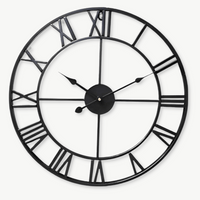

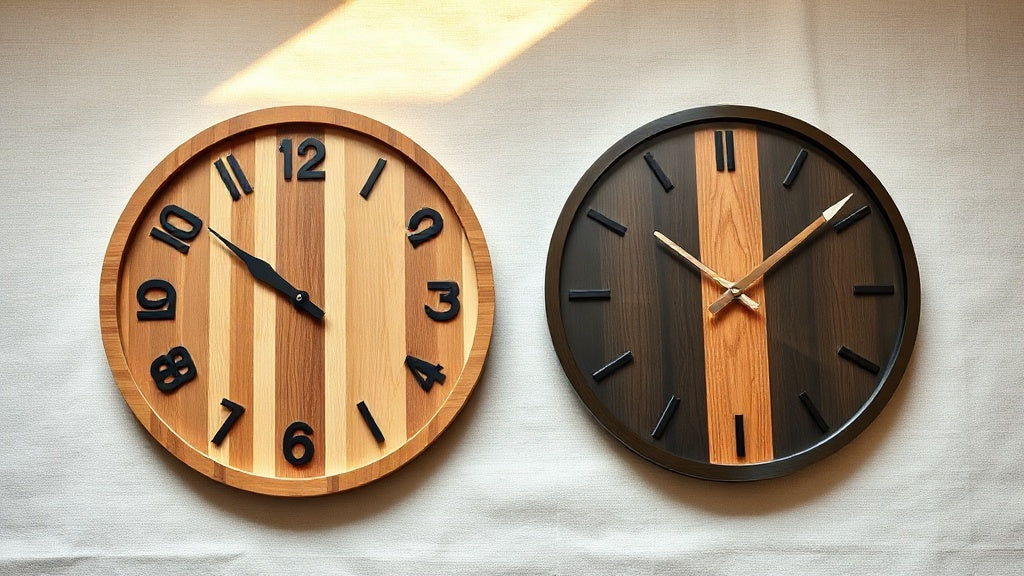
You've measured the wall. You've picked the spot. And now you're staring at two tabs on your screen: a beautiful bamboo clock with warm grain markings, and a brushed metal piece with that satisfying industrial weight. Both look right. Neither is obviously wrong. This is where most people get stuck.
The question of wooden vs metal wall clock: which is better doesn't have one universal answer, but it does have a right answer for your space, your style, and honestly, your lifestyle. Here's how to figure out which one that is.
At a glance
- Wood reads warm, organic, and quiet - ideal for bedrooms, living rooms, and Scandinavian-style spaces.
- Metal reads bold, precise, and structured - ideal for kitchens, offices, loft apartments, and industrial aesthetics.
- Weight matters more than you'd expect: metal clocks over 40 cm often need a wall anchor, not just a hook.
- Both materials are available with silent quartz movements, so ticking noise isn't a deciding factor.
- The right choice depends less on the material itself and more on the room's existing palette and texture mix.
What Wood Actually Brings to a Wall (Beyond "Natural Vibes")
Wooden wall clocks have had a genuine resurgence since the mid-2010s, and it's not just a trend cycle playing out. There's something functionally different about how wood performs on a wall. The material absorbs light rather than reflecting it, which makes a wooden wall clock feel like it belongs in a room rather than demanding attention from across it.
Bamboo, in particular, has become the go-to choice for the more considered end of the market. It's technically a grass (not a hardwood), which means it grows fast, machines cleanly, and produces a consistent grain that works beautifully at any clock size. Oak and walnut frames tend to be heavier and more variable in grain - which some buyers love for the uniqueness, but others find unpredictable when ordering online. I'll be honest: when I first switched from a painted MDF clock to a solid bamboo piece in my own living room, the difference in how the room felt was immediate. That grain does something no flat finish can replicate.

From a weight perspective, a 30 cm wooden clock typically sits between 400-700 grams depending on thickness. That means a standard picture hook handles it without drama. Plasterboard walls, rental apartments, no-drill setups: wood is almost always the easier hang. If you're navigating a rental and trying to avoid deposit drama, this detail alone can settle the debate.
The acoustic quality is also worth noting. Wood is a natural dampener. A clock with a wooden case around the movement will be marginally quieter than the same movement in a thin metal case, even if both are technically "silent quartz." The case material does affect resonance, and in a bedroom where every tiny sound is amplified by 2am silence, that margin is real.
Where Metal Wall Clocks Win - and Why It's Not Just About Looking "Industrial"
Metal clocks get unfairly boxed into the industrial-loft category. Yes, that's where they shine most dramatically, but a thin powder-coated metal frame in matte black works just as well in a modern Scandinavian kitchen as any bamboo piece. The material's real strength is versatility of finish: you simply cannot achieve the depth of a copper patina, the crispness of a brushed gold, or the graphic punch of a perforated black steel dial in wood. These are finishes that change character depending on the light hitting them, and that's genuinely exciting in a way that's hard to convey in a product photo.
Metal also holds its shape. Wood can expand and contract seasonally in humid rooms (bathrooms, kitchens near a stove, rooms without climate control). Metal doesn't. A metal clock in your kitchen will look exactly the same in July as it does in January. When you're buying a piece you intend to keep for a decade, that predictability is actually a feature, not a consolation prize.

The durability of a quality metal wall clock is genuinely hard to match. A pressed steel or cast iron case, properly finished, handles knocks, humidity, and UV exposure without warping, fading, or splintering. The same cannot be said for cheaper wood-effect laminates or MDF frames that sometimes get sold as "wooden clocks" without being upfront about the material. Always check whether a listing says "solid wood" or just "wood finish." That phrasing gap is where a lot of buyer disappointment lives.
One honest caveat: larger metal clocks are heavier. A 50 cm metal clock can weigh 2-3 kg, which requires a proper wall anchor into a stud or a masonry wall. It's not a dealbreaker, but it's a real step that catches renters off guard. Plan your wall fixing before the clock arrives, not after.
Did you know?
The first mass-produced metal-cased wall clocks appeared in American factories around the 1880s, driven by demand for durable timepieces in train stations and factories. Their design language, bold numerals, exposed faces, visible mechanics, translated directly into the industrial interior aesthetic that's still popular in 2026.
Side-by-Side: How the Two Materials Compare Across What Actually Matters
| What to consider | Wooden wall clock | Metal wall clock |
|---|---|---|
| Aesthetic tone | Warm, organic, quiet | Bold, structured, graphic |
| Weight (30 cm) | 400-700 g (standard hook) | 700 g-1.5 kg (hook or anchor) |
| Humidity resistance | Moderate (avoid steam zones) | High (treated/powder-coated) |
| Sound resonance | Slightly lower (wood dampens) | Slightly higher (metal resonates) |
| Finish variety | Natural, stained, painted | Copper, gold, black, brushed, chrome |
| Ideal interior styles | Scandinavian, japandi, rustic, boho | Industrial, modern, art deco, minimalist |
| Longevity | 10-20 years (solid wood/bamboo) | 15-30+ years (quality steel/iron) |
| Entry price | From ~$50 | From ~$39 (pressed steel) to $250+ |
Matching the Material to Your Room - a Practical Room-by-Room Guide
This is where the debate gets useful. Rather than picking a "winner," here's what works where, based on how light, texture, and scale actually play out in each space.
Living Room
If your living room already has natural textures, linen sofas, rattan, exposed wooden beams, or a parquet floor, a wooden wall clock reinforces the layering beautifully without competing. If your living room skews more architectural, with concrete, marble, or a monochrome palette, a large metal piece becomes the warm accent rather than a cold intrusion. Think of it this way: if your room is already whispering, wood whispers back. If it's already making a statement, metal joins the conversation properly.
Kitchen
Kitchens are the one room where metal consistently wins. Humidity from cooking, steam, and grease particles are facts of life, and a properly sealed metal clock handles all three without complaint. A well-chosen industrial wall clock on a kitchen wall also does something interesting: it references the functional, practical nature of the space while still being deliberate about design. That tension between utility and beauty is exactly what good kitchen styling is.
Bedroom
The bedroom is wood territory, almost categorically. You want low visual noise, materials that read as calm, and absolutely no ticking (which means checking the movement specs regardless of the casing). A bamboo or oak clock in a bedroom reads as intentional rather than decorative. It's the difference between a piece that helps you slow down and one that keeps the room buzzing. If you're building a *japandi* or Scandinavian bedroom and want everything to feel curated without feeling cold, a natural bamboo piece is your lowest-risk, highest-reward choice.
Home Office
This depends on whether your office is a creative space or a productivity space. Creative studios often suit wood because it keeps the visual environment settled. But a structured, clean home office setup frequently benefits from the graphic clarity of a metal clock. The bold hands and high-contrast dial typical of metal designs are simply easier to read at a glance across a desk. And honestly? There's something about a well-designed metal clock in a home office that signals you take the space seriously, without turning it into a corporate corner.
The Durability Question: What Holds Up Over 10 Years
Here's the honest version: both solid wood and quality metal clocks will outlast most of the furniture around them. The difference isn't longevity so much as how each material shows its age, and whether you'll love what you see.
Solid bamboo and hardwood clocks age gracefully. The grain deepens slightly, a light patina develops, and the piece starts to look like something that was chosen carefully rather than grabbed conveniently. The risk with wood comes at the budget end: MDF or compressed-wood frames wrapped in veneer can delaminate in humid environments, and the finish scratches much more easily than solid wood. If a listing doesn't say "solid" somewhere, ask before you buy.
Quality metal wall clocks age differently. A powder-coated steel frame stays visually consistent for years with minimal upkeep, just wipe it down. Copper and brass-finished pieces will develop a natural *patina* over time, which many owners come to love but some don't anticipate when buying. Raw or minimally treated iron can show surface rust near moisture sources, so it's worth scanning product descriptions carefully before hanging one in a kitchen or bathroom. When in doubt, look for "powder-coated" or "sealed finish" in the spec.
One thing that's identical across both materials: the movement. Whether the case is walnut or cast iron, the quartz mechanism inside typically runs for 2-5 years on a single AA battery and can be replaced cheaply at any hardware store. The clock outlives the battery by a long stretch. Don't let battery replacement frequency factor into your material decision.
When You're Actually Better Off Mixing Both

Here's something that doesn't come up enough: the wooden vs metal wall clock debate assumes you're only hanging one clock in your home. Many people aren't. And when you start thinking about a coordinated approach across multiple rooms, mixing the two materials is often the most interesting solution.
A large wooden clock in the living room and a metal piece in the kitchen is a pairing that interior stylists use regularly because the materials carry different "temperatures." Wood is warm; metal reads cooler. That thermal contrast between rooms makes a home feel considered rather than simply decorated, and it's one of those tricks that costs nothing extra but makes everything look more intentional.
Within a single room, you can also layer materials at different scales. A large bamboo clock on the wall, with a small metal desk clock on a side table below it, creates a vertical moment that works especially well in home offices and bedrooms. The key is keeping one material dominant and treating the other as an accent. Split it 50/50 and the room starts to feel like it's arguing with itself. One rule of thumb: let the larger piece set the tone, then let the smaller piece add the twist.
You can browse the full range of wooden wall clock options and all wall clock styles side by side if you're working on a multi-room approach.
"A clock tells time. A good clock tells something about the person who chose it."
A sentiment shared by many of our customers when describing why they spent time choosing the right material.
Five Questions to Ask Yourself Before You Buy
Skip the endless scrolling. These five questions cut through faster than any style quiz, and I'd genuinely encourage you to answer them out loud before you add anything to a cart.
- What's the dominant texture already on that wall? Smooth plaster suits both. Brick or stone calls for metal. Wallpaper or wood paneling usually wants a wooden clock alongside it, not competing with it.
- Is humidity a factor in the room? Steam, condensation, or cooking spray? Metal wins, full stop. Dry, climate-controlled space? Both work equally well and the decision becomes purely aesthetic.
- How large does the clock need to be? Above 40 cm, metal clocks get heavy fast. Wood stays manageable at larger sizes, which is why oversized wooden clocks have become a living room staple in Scandinavian and *japandi* interiors.
- Do you want the clock to blend or contrast? Wood blends with organic, warm, texture-rich rooms. Metal contrasts beautifully in soft, textile-heavy spaces. Neither is better; they're doing different jobs.
- Are you in a rental? Lighter wooden clocks are significantly more renter-friendly. No wall anchors, no masonry drilling, no deposit deductions when you move out. A 500g bamboo clock on a picture hook is a very different commitment to a 2.5kg steel piece.
What Customers Actually Say After Living With Both
Patterns emerge when you read enough customer reviews side by side. People who chose wooden clocks consistently mention how the piece "feels right" in the room, how it doesn't demand attention but rewards it when you notice it. The word "cozy" comes up a lot, even in modern or minimal interiors. There's also a recurring theme of people saying they weren't sure about wood before buying, but can't imagine the room without it now. That's the bamboo effect: understated until it isn't.
People who chose metal clocks tend to talk about how the piece "anchors" the room. Words like "bold," "precise," and "exactly what I was looking for" appear frequently. There's also a recurring mention of how the clock looked better in person than expected, which speaks to metal's ability to reflect changing light throughout the day in ways photography genuinely doesn't capture. A copper-finish metal clock at golden hour looks like a completely different object than it does at noon.
The regrets? Mostly about size, not material. Customers who bought too small wish they'd gone larger. Almost nobody wishes they'd switched materials entirely. Which is reassuring: once you've thought through the room properly, you'll likely get the material call right on the first try.
FAQ: Wooden vs Metal Wall Clock
Is a wooden wall clock durable enough for a kitchen?+
Solid bamboo and hardwood clocks handle most kitchen environments well, provided they're not hung directly above a stove or kettle where steam is concentrated. MDF or veneer-based "wood-look" clocks are a different story and don't hold up well in humidity. If your kitchen runs warm and steamy regularly, a powder-coated metal clock is the safer long-term choice.
Do metal wall clocks tick louder than wooden ones?+
It depends more on the movement than the case. Both wooden and metal clocks can house either a standard quartz movement (which ticks audibly) or a silent sweep movement (no tick). That said, a thin metal case can amplify vibrations slightly more than a solid wood frame. If silence is a priority, check the product listing for "silent quartz" or "sweep movement" regardless of which material you're buying.
Which material works better in a Scandinavian-style home?+
Both can work, but wood is the more natural fit. Scandinavian design principles prioritize natural materials, functional simplicity, and warmth - all of which bamboo and light oak deliver well. Matte black metal clocks also work in Scandi interiors when the rest of the room uses black accents (window frames, tap fixtures, shelving supports), because the material consistency ties the space together cleanly.
How heavy are large metal wall clocks, and what do I need to hang them?+
A 50 cm metal clock typically weighs between 1.5 and 3 kg depending on construction. For plasterboard walls, you'll want a wall anchor rated for at least double the clock's weight, screwed into a stud where possible. On solid masonry walls, a rawlplug and screw is straightforward. Most metal clocks ship with basic hanging hardware, but checking the weight spec before buying and planning your wall fixing accordingly saves a lot of frustration on installation day.
Can I hang a metal clock on drywall without drilling into a stud?+
For clocks under 1 kg, a drywall anchor (the expanding plastic or toggle-bolt type) is usually sufficient on its own. For anything heavier, especially metal clocks over 40 cm, anchoring into a stud is strongly recommended. If you're unsure, use a stud finder first - it takes two minutes and saves a lot of plaster repair later. Most metal clocks over 50 cm include a note about recommended fixings in the product description.
How often do I need to replace the battery in a wall clock?+
Most wall clocks with a standard quartz movement run for 1-2 years on a single AA battery, and silent sweep movements can run slightly longer since they draw less power. Using a quality alkaline or lithium AA rather than a no-brand cell makes a real difference to runtime. When the clock starts losing a minute or two per week, that's your first sign the battery is fading - worth replacing before it stops completely and disrupts your time setting.
Can I mix a wooden clock and metal clock in the same room?+
Yes, and it often looks more considered than matching materials across the board. The key is scale: make one material dominant (usually the larger wall piece) and treat the other as an accent at a smaller size. A large bamboo wall clock paired with a small metal desk clock below it creates a layered moment that feels styled rather than accidental. Let one material lead, and the other follow.