
You've seen them everywhere. The wall clock that looks perfect in the product photo, arrives in a thin cardboard box, ticks loud enough to keep you awake, and starts running slow within six months. It's a frustrating experience, especially when you were genuinely trying to buy something that would last. What makes a wall clock high quality isn't mysterious, but the signals aren't always obvious when you're browsing online. Here's what actually matters, broken down without the fluff.
Key takeaways
- The movement type (quartz vs. mechanical) is the single biggest factor in long-term reliability.
- Frame material determines both visual character and how the clock ages over time.
- Dial clarity and hand finish affect everyday usability just as much as aesthetics.
- Silent sweep mechanisms are a practical upgrade for bedrooms, offices, and open-plan spaces.
- Weight and mounting hardware are quality signals most buyers overlook entirely.
The Movement: Where Quality Actually Starts
Every conversation about high-quality wall clock movements begins in the same place: the mechanism hidden behind the dial. This is the component that does the actual work, and it's the one most buyers never think to ask about.
Quartz movements run on a battery and use the vibration of a quartz crystal, typically at 32,768 Hz, to regulate timekeeping. A well-made quartz movement loses or gains fewer than 15 seconds per month. A cheap one can drift by several minutes. The difference comes down to the quality of the oscillator and the tolerances in the gear train.
Within quartz movements, there's an important split: stepped movements tick once per second (that familiar ticking sound), while sweep movements move continuously and almost silently. For a bedroom, study, or anywhere you spend quiet time, a silent sweep quartz is genuinely worth the extra cost. It's not a marketing claim; you notice it immediately. If you're weighing up which type suits your space, the silent wall clock collection is a good place to start comparing.

Mechanical movements are a different category altogether. They're wound by hand or by a self-winding rotor, contain no battery, and rely entirely on the precision of their gear train and *escapement*. They require more care, more maintenance, and more investment. But for collectors or those who value the craft of *horology*, the visible mechanism is the point. You're not just buying a timekeeper; you're buying a working object with a history.
Did you know?
The quartz crystal used in clock movements vibrates at exactly 32,768 times per second, a number chosen because it's 2 to the power of 15, which makes it easy for digital circuits to count down to one precise second. This principle, developed in the 1920s by Warren Marrison at Bell Labs, is what makes even affordable quartz clocks remarkably accurate today.
Frame and Case Materials: The Difference You Can Feel
Pick up a cheap clock. Now pick up a well-made one. The weight difference alone tells you something real. Heavier doesn't always mean better (a solid bamboo frame is lighter than cast iron but still high quality) but a frame that feels hollow or flimsy under your hands usually is.

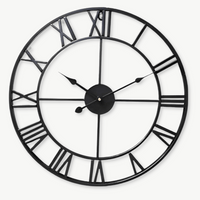
Metal frames, particularly brushed steel, powder-coated iron, and copper-finished alloys, are durable, hold their finish well over years, and read clearly on most wall colors. The quality indicators here are clean weld points, smooth edges with no burrs, and a coating that doesn't flake or scratch easily. Industrial and Bauhaus-style clocks lean heavily on raw or patinated metal; when the finish is done properly, it develops character rather than just looking worn.
Solid wood and bamboo frames offer warmth that no synthetic material replicates convincingly. Real wood grain varies slightly across pieces; that's a feature, not a defect. Bamboo specifically is dimensionally stable (it resists warping in humidity fluctuations), naturally fast-growing, and increasingly common in Scandinavian-influenced designs. The question to ask is whether the frame is solid or veneer over MDF. Solid holds up over decades; thin veneer on composite board starts delaminating within a few years, especially near kitchens and bathrooms.
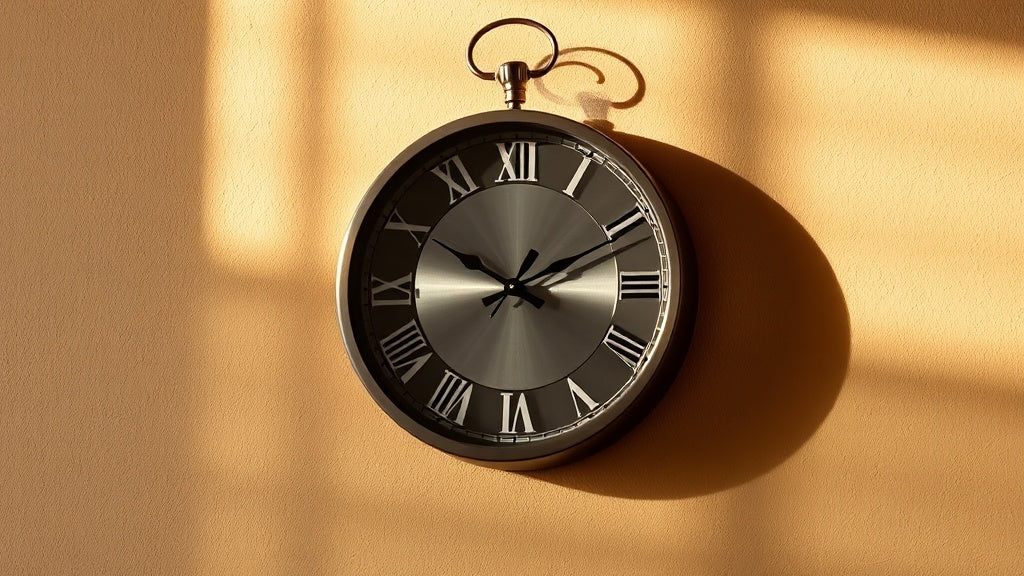
Acrylic and glass dials or cases deserve a separate note. Acrylic scratches more easily than glass but is far less prone to shattering in the event of a knock. Tempered glass is the premium option: harder, clearer, and resistant to impact. On a 12-inch clock, this might feel like a minor point. On a 50 cm or 60 cm statement piece hung at eye level, the optical clarity of genuine glass makes a visible difference in how sharp the dial reads from across a room.
The Dial: Legibility Is a Quality Marker
A clock dial that's hard to read at a glance has failed at its primary job. This sounds obvious, but a surprising number of decorative clocks prioritize visual style so heavily that the hands get lost against a busy background, or the numerals are sized for effect rather than function.
High-quality dials share a few consistent traits. The contrast between hands and face is strong enough to read from 3-4 meters away. The numerals, whether Arabic, Roman, or baton indices, are applied cleanly with no smearing or misalignment. On premium pieces, numerals are applied as raised metal or resin elements rather than printed directly onto the surface; the tactile depth adds visual clarity and ages well.
Hand finish matters more than most buyers expect. Spade, dauphine, and baton hands in polished, brushed, or matte finishes each catch light differently. Cheap hands feel thin and bend slightly when you set the time; quality hands have real weight and spring back precisely. On sweep-movement clocks, the second hand glides rather than steps, but it should do so with zero wobble and no contact with the dial surface.
Size, Proportion, and the Visual Weight Question
A high-quality wall clock chosen in the wrong size reads as cheap, even if it isn't. This is a design problem, not a product problem, but it's worth addressing because proportion is often where buyers go wrong.
The standard advice of "measure your wall" is a starting point, not a complete answer. What you're really calibrating is visual weight: how much presence the clock commands relative to other objects in the room. A 30 cm clock on a large empty wall reads as afterthought decor. A 60 cm clock in a narrow hallway reads as an obstacle. The sweet spot for most living rooms sits between 40-60 cm for a primary statement piece.
Rooms with high ceilings, exposed brick, or large sofas as anchor points can carry clocks in the 50-80 cm range without visual overload. Kitchens and studies typically work better with 25-35 cm, where the clock stays functional without dominating the space. Bedrooms depend almost entirely on whether the clock is the focal point or a supporting element. For bedrooms especially, size and silence work together; a 30 cm sweep-movement clock is almost undetectable on a nightstand wall, while a 55 cm stepped-movement piece will absolutely announce itself at 2 am.
Quick sizing rule
As a practical shortcut: the clock diameter should be roughly one-third the width of the wall section it occupies. A 120 cm wide alcove calls for a 35-45 cm clock. A full 3-meter living room wall can carry 60-80 cm comfortably. It's not a rigid formula, but it stops you going too small far more often than it causes problems.

| Room | Recommended Size | Key Priority |
|---|---|---|
| Living room | 40-65 cm | Statement presence, legibility from sofa |
| Bedroom | 25-40 cm | Silent movement, low visual distraction |
| Kitchen | 25-35 cm | Easy readability, humidity-resistant material |
| Home office / study | 30-45 cm | Minimal ticking, sharp dial contrast |
| Hallway / entryway | 30-50 cm | Proportional to wall width, first impression |
Finish Quality: What Separates Lasting from Fading
The finish on a clock is the part that changes over time, and the way it changes tells you everything about the original quality of the piece. Good finishes age with dignity. Poor ones flake, yellow, or oxidize in ways that look accidental rather than intentional.
On metal clocks, powder coating is the current standard for durability. It bonds to the metal surface electrostatically before being cured at high temperature, producing a finish that's harder, more chip-resistant, and longer-lasting than liquid paint. A quality powder coat feels smooth and even; a poor one shows texture irregularities, thin patches near edges, and tends to chip at corners.
Patina and aged finishes on vintage or industrial-style clocks are a specific case. When done well, the aging is applied intentionally and sealed; it stays consistent over years. When done poorly, the "patina" is a thin wash that continues to change unpredictably after purchase, usually not in a direction you'd choose. Asking whether the finish is sealed is a reasonable question to any retailer who knows their product.
On wooden clocks, the distinction between a genuine oiled or lacquered wood finish versus a printed wood-look paper wrap on MDF is critical. Real wood grain has depth; printed wood grain is perfectly uniform and flat. You can tell the difference by looking at an edge or a cut; real wood shows grain continuity, composite materials show layers.
Mounting Hardware and Back Plate: The Overlooked Detail
Here's something almost no buying guide mentions: the quality of the hanging hardware is a direct proxy for overall build quality. Manufacturers who care about the product build in proper keyhole slots, reinforced back plates, or integrated brackets that distribute the clock's weight evenly across the anchor point. Manufacturers who don't care throw in a single thin wire that lets the clock tilt forward whenever a door closes nearby.
For clocks under 1 kg, a central keyhole mount is fine. For anything over 1.5 kg (and most metal wall clocks with a diameter above 40 cm fall into this category), a two-point mount or a wide back frame is worth having. It keeps the clock flush to the wall, prevents forward tilt, and makes the piece look intentional rather than improvised.
The back plate of a quality clock also covers the movement cleanly. Exposed quartz movements (not intentionally decorative ones) suggest a cost-cutting approach to the whole build. A clean, enclosed case back, ideally with a battery access panel that doesn't require tools, is a minor point that speaks to thorough design thinking throughout.
"A clock is one of the few objects in a home that gets read dozens of times a day without being consciously noticed. That's exactly why its quality matters; you feel it long after you've stopped seeing it."
Elena Rossi, on why wall clocks repay close attention at the point of purchase
Style and Material Coherence: When Quality Meets the Room
A quality wall clock that clashes with its environment reads as cheap even if it isn't. The final quality indicator isn't in the object itself; it's in the fit between the clock, the wall, and the room's existing materials.
Scandinavian-style interiors with light oak, linen, and neutral walls carry bamboo, birch, and pale wood clocks naturally. The material language is consistent. Industrial loft spaces with exposed concrete, raw steel fixtures, and leather furniture can carry copper-finished or matte-black iron clocks without effort. These pairings feel resolved because the materials are speaking the same visual dialect.
The trickier situation is an eclectic or transitional interior, where different periods and materials coexist. Here, the safest approach is to lean on the clock's finish rather than its style: a brushed brass or satin nickel finish reads as neutral enough to bridge most interior palettes without dominating them.
When in doubt, browse by room rather than by style; it forces a more honest assessment of what actually fits the space. You can also explore wooden wall clocks if you're working with a warm-toned interior, or browse the industrial wall clock collection for metal-forward spaces that need strong visual anchoring.
The Real Cost of Buying Cheap (and What to Spend Instead)
A $15 clock from a mass-market retailer will likely need replacing within two to three years. The movement drifts. The frame warps slightly in humidity. The finish starts chipping at the edges. You end up buying twice, or three times, for the same wall space.
The practical quality threshold for a reliable, well-made wall clock with a silent quartz movement, a solid frame, and a finish worth looking at sits somewhere between $50 and $150 for most standard sizes. Below that range, compromises compound quickly. Above $150 you're typically moving into premium materials, larger formats, or mechanical movements that carry a different kind of value proposition.
The most useful mental model: think of a quality clock as a per-day cost. A $100 clock that lasts 15 years costs about 1.8 cents a day to own. That context tends to recalibrate what "expensive" actually means for something you'll look at 30 or 40 times a day. You can explore the full best-selling clock selection to see which pieces consistently hold up to that standard, or check the luxury wall clock collection if you're investing in a room's focal point.
Frequently asked questions about wall clock quality
What's the difference between a sweep and a ticking quartz movement?+
A stepping (ticking) quartz movement advances the second hand once per second with an audible click. A sweep movement drives the second hand continuously and nearly silently. Both are equally accurate timekeepers; the difference is purely in noise level and hand motion. For bedrooms or quiet workspaces, sweep movements are significantly more comfortable to live with.
Is a heavier wall clock always a better-quality clock?+
Not always, but heavier frames in metal or solid wood often do indicate denser, more durable materials. A bamboo clock can be lighter than a metal one and still be high quality. The key is consistency: a clock that feels hollow or lightweight relative to its stated material is usually hiding a cheaper composite underneath. Weight matters most as a consistency check, not an absolute rule.
How do I know if a clock's finish will last?+
On metal clocks, powder coating outlasts spray paint significantly. You can test it by pressing a fingernail lightly at a seam or edge; quality coating doesn't indent or chip under light pressure. On wood, a properly lacquered or oiled finish feels smooth with no peeling at edges. Any finish that smells strongly of chemicals after unpacking (beyond normal manufacturing) is worth querying with the retailer.
Can I put a quality wall clock in a kitchen or bathroom?+
Kitchens are fine for most metal, acrylic, and bamboo clocks; the humidity fluctuation is manageable. Solid wood clocks can warp near a stove or dishwasher vent over time, so positioning matters. Bathrooms with poor ventilation are genuinely challenging: steam can affect quartz movements if moisture penetrates the case. For bathrooms, look for sealed cases or clocks specifically listed as humidity-resistant.
How often should I replace the battery in a quality quartz clock?+
A well-made quartz movement running on a standard AA or AAA battery typically needs replacing every 12 to 18 months under normal conditions. Sweep movements draw slightly more current than stepping movements, so they may need a fresh battery closer to the 12-month mark. Using a quality alkaline battery (rather than a budget zinc-carbon cell) extends that window noticeably and reduces the risk of leakage damaging the movement.
What makes a wall clock high quality versus just expensive?+
Price and quality don't always move together. A genuinely high-quality wall clock has a sealed, accurate quartz or mechanical movement; a frame in solid rather than composite material; a finish that's been properly applied and sealed; hardware that mounts the piece flush and stable; and a dial with enough contrast to read from across the room. Expensive clocks add premium materials, larger formats, or mechanical complexity. But a well-made clock at $80-$120 will outperform a poorly made clock at $200 on every practical measure.