
You've probably stood in front of a wall, clock in hand, and thought: this just doesn't feel right. Not the placement. The clock itself. There's a flatness to it, a sense that it could belong in any room, in any house, anywhere. That's the mass-production problem. A wooden wall clock handmade quality piece feels different from the first second you hold it. The weight sits differently. The grain pulls your eye. You notice it the way you'd notice a well-made chair or a hand-thrown ceramic bowl.
This isn't about paying more for a label. It's about understanding what you're actually getting when a maker spends real time on a piece of wood before it ever becomes a clock. Elena Rossi, our in-house decor consultant, puts it simply: "A handmade wood clock is the one thing on your wall that earns more attention the closer you get to it. Everything else loses detail. These gain it."
À retenir
- Handmade wooden clocks use solid or sustainably sourced wood, not MDF or veneer over particle board.
- The movement matters as much as the case: a quality silent quartz mechanism keeps a wood clock precise and quiet for years.
- Grain direction, joinery, and finish type are the three fastest ways to separate crafted pieces from factory output.
- Wood species choice (bamboo, oak, walnut, ash) directly affects both durability and the visual character of the clock.
- A handmade clock placed correctly becomes architecture for a wall, not just an accessory hung on it.
Why Wood Became the Go-To Material for Statement Wall Clocks
Wood has been used in clockmaking since the 17th century, and not just because it was available. It machines precisely, holds tolerances well when properly dried, and ages in a way no synthetic material mimics. An oak clock that's five years old looks better than it did new. A plastic clock that's five years old just looks old.
Beyond the aging argument, wood brings something specific to a room's energy. It absorbs sound rather than bouncing it back. Its natural variation means no two pieces look identical. And it bridges the gap between styles that otherwise resist each other: a bamboo clock reads as Scandinavian in a minimalist flat but feels just as natural in a rustic kitchen with exposed brick. That kind of flexibility is rare in decor.
The renewed appetite for handmade wooden pieces after 2020 also tracks with a broader shift. People started paying attention to what was on their walls during long stretches at home, and a lot of what they saw felt hollow. Searches for artisan-made, sustainably sourced homewares climbed sharply through 2023 and haven't come back down. Wooden wall clock handmade options, especially those with clear craft intent, became part of that recalibration. If you're curious how wood clocks fit alongside other premium options, the luxury wall clock collection shows the full range of what "investment piece" means in this category.

Solid Wood vs. Engineered Wood: The Distinction That Actually Matters
Here's where things get practical. Not every clock marketed as "wooden" is built the same way, and the difference isn't cosmetic.
Solid wood means the structural body of the clock is cut from a single piece or glued sections of real timber. You'll see the grain on the edges as well as the face. It can be sanded, refinished, and repaired. It reacts slightly to humidity, which is normal and not a defect.
MDF with wood veneer is the most common shortcut. A thin slice of real wood is pressed onto medium-density fiberboard. It photographs well, costs far less to produce, and is lighter to ship. The problem: the veneer is typically 0.5 to 2 mm thick. One chip and you're looking at grey-brown composite underneath. It doesn't age; it degrades.
Bamboo occupies its own category. Technically a grass, bamboo is engineered into boards through a lamination process that results in a material harder than most hardwoods, with a Janka hardness rating above red oak. It's dimensionally stable, grows to harvest maturity in 3 to 5 years versus 20 to 80 for hardwood timber, and has a distinctive horizontal grain pattern that reads as clean and modern on a wall. It's also Elena's personal favourite starting point for anyone new to the category, because it's forgiving across nearly every interior style.
| Criterion | Solid / Bamboo Wood | MDF + Veneer |
|---|---|---|
| Edge appearance | Grain visible on all edges | Smooth, painted, or edged with separate strip |
| Repairability | Sandable, re-oilable, very good | Chips are permanent, poor |
| Weight feel | Substantial, warm | Light, hollow-feeling |
| Aging over 5+ years | Develops patina, improves | Discolors, swells at edges in humidity |
| Sustainability | FSC-certified and bamboo options widely available | Adhesives often contain formaldehyde; harder to recycle |
Reading the Craft: Five Details That Tell You a Clock Is Actually Handmade
Product listings use "handmade" loosely. Here's what to actually look for when evaluating whether a clock was genuinely made by hand or just touched by one at the end of a production line.
- Irregular grain matching at joints. On a truly handmade clock with a multi-piece face, the craftsperson selects and orients boards for visual continuity. Factory work cuts whatever's next in the stack. Mismatched grain at seams is the clearest tell.
- Hand-applied finish rather than dip or spray. Oil finishes, beeswax, or hand-rubbed lacquers show slight variation in sheen when you tilt the clock in light. Spray-line finishes are perfectly uniform, which sounds like a virtue but reads as lifeless on natural wood.
- Routed or chiseled numeral positions, not printed. High-quality wood clock faces have numbers either cut into the surface, laser-engraved deep enough to cast a shadow, or applied with metal hardware. Stickered or surface-printed numbers peel within two to three years in normal humidity cycles.
- Hand-bent or hand-shaped clock hands. Metal hands on a craft clock are often individually shaped and finished, with visible tool marks or hand-painted tips. Factory hands come from a press, identical to the thousandth of a millimeter.
- Movement housing quality. On a handmade clock, the cavity cut into the wood for the movement is clean, precisely sized, and often fitted with a dust cover. Rough, oversized cutouts filled with foam packing tell you the case was mass-produced first and the movement dropped in wherever it fit.

Did you know?
The Black Forest region of Germany has been producing handmade wooden clocks since the late 1600s. At its peak in the 19th century, the region's cottage workshops were turning out approximately 3 million clocks per year, each one assembled by a single family unit working from raw timber to finished piece. That tradition of treating the clock as a whole object, not a set of outsourced parts, is the baseline against which modern handmade claims are still measured.
The Movement Inside: Why It's Half the Story
A beautiful wood case housing a noisy, imprecise movement is a beautiful disappointment. Clock movements are almost universally sourced separately from the case, even on handmade pieces, so understanding what to look for here matters independently of who built the frame.
The standard for everyday handmade wood wall clocks is a silent quartz movement, and the silence part deserves emphasis. Older quartz mechanisms use a step-motor that advances the second hand in discrete ticks, each one producing a click loud enough to notice in a quiet room. Continuous sweep quartz movements, often called "sweep" or "silent quartz," run the second hand in a smooth continuous motion with near-zero audible output. In a bedroom, a home office, or an open-plan living space, this isn't a luxury; it's the baseline.
Battery life on a quality movement runs 12 to 18 months on a single AA cell. Movements by Seiko (Japan) and UTS (Germany) are widely considered the benchmark for longevity at this price tier. If a product listing doesn't specify the movement brand or origin, that's worth asking about before purchasing.
Wood Clock Styles and the Rooms Where They Actually Work
One of the most common questions people run into is pairing: which wood clock style works in which space? There's no absolute answer, but there are patterns worth knowing.
Scandinavian and Nordic Minimalism
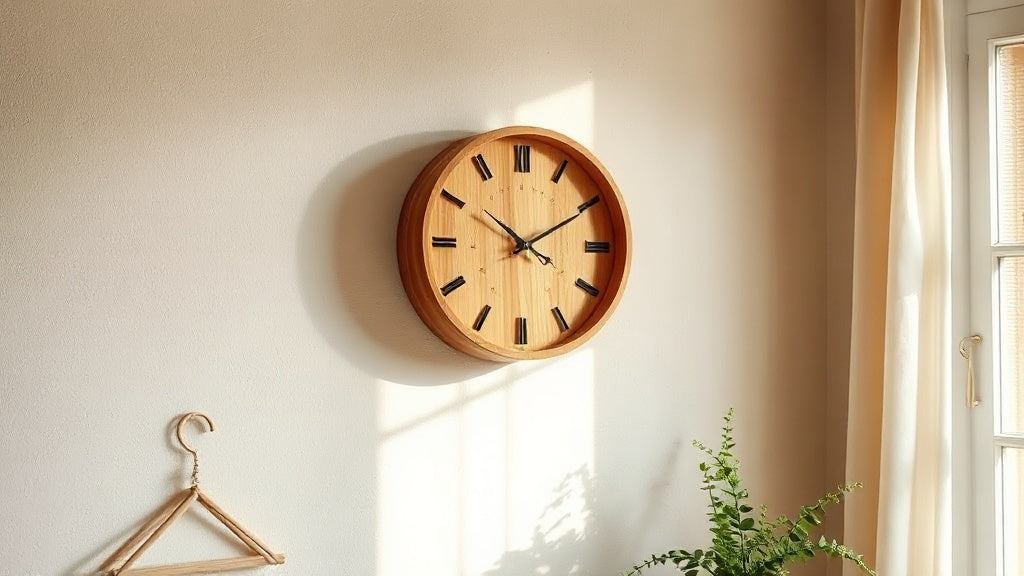
Pale woods (ash, birch, light bamboo) with clean round cases and minimal or no numerals read as quintessentially Nordic. They work best on white or very light grey walls, where the warmth of the wood provides contrast without visual noise. Black hands on a natural wood face is the classic combination here. The Scandinavian wall clock collection covers this territory well for anyone building a Nordic-inspired room, with options ranging from 30 cm minimalist discs to larger statement pieces above a sideboard.
Japandi and *Wabi-Sabi* Interiors
Darker bamboo or smoked oak finishes, irregular grain, and asymmetric hand shapes suit the Japandi aesthetic (Japanese-Scandinavian fusion) that dominated interior design through 2024 and shows no sign of retreating. These clocks work particularly well above a low console or floating shelf, where the space below the clock creates breathing room rather than visual clutter. Think muted earth tones, textured linen cushions, and a single ceramic vase: the clock should feel like it grew from that context, not arrived from somewhere else.
Rustic, Farmhouse, and Cottagecore
Thicker cases with visible joinery, knot-inclusive wood slabs, and Roman numeral faces fit naturally in kitchens with open shelving, entryways with shiplap walls, or bedrooms styled around natural linen and aged brass. The key here is avoiding anything that looks too refined or finished; the charm of the style is its honest, slightly imperfect character. A hand-oiled walnut or reclaimed pine clock face, with visible grain irregularity, is more at home here than anything that looks freshly lacquered.
Modern Industrial
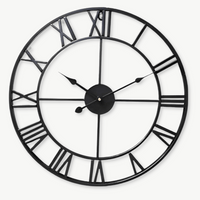
Wood paired with metal hardware, exposed screws, and darker stains (ebony, walnut, blackened oak) carries well into industrial spaces. A wood and metal hybrid clock on an exposed brick wall is one of the most consistently well-received combinations in customer setups. It bridges two material worlds without forcing either one to compromise. Elena's personal rule for industrial interiors: keep the wood dark, keep the metal matte, and let the clock be the warmest thing on that wall.
Sizing a Handmade Wood Clock to Your Wall
This is where a lot of people get it wrong, and it's almost always in the same direction: too small. A handmade clock with real presence needs wall real estate to breathe. The general rule that works across most rooms is that the clock diameter should be roughly one-third to one-half the width of the furniture piece or architectural element it anchors. Above a 60-inch sofa, you're looking at a 20-to-30-inch clock for balanced visual weight. It's less a formula and more a gut check: does the clock look like it belongs there, or does it look like it's apologising for existing?
For walls without furniture reference points, like a staircase wall or an entryway, the calculation changes. Here, the clock competes with architectural features rather than furniture. A larger piece, 24 inches or above, reads as intentional rather than accidental. Anything smaller on an open wall tends to look like it was hung there temporarily and never moved.
Placement height follows a simpler rule: eye level for a seated adult is approximately 57 to 60 inches from the floor, and that's the sweet spot for the center of a clock in a living room or bedroom. In a kitchen, where most interactions happen standing, 65 to 68 inches centers the face comfortably. Going higher than 72 inches on any clock tips into purely decorative territory and makes the piece harder to read, which can defeat the purpose on a functional timepiece.

How Handmade Wood Clocks Fit into a Larger Decor Story
A clock doesn't live in isolation. It sits in a context of paint colors, textiles, furniture finishes, and lighting, and the most successful clock placements are the ones where the maker's material choices happen to rhyme with what's already in the room.
Here's what that looks like in practice. A bamboo wall clock with a leaf-cut face on a warm-white wall above a rattan console, with a linen runner and a handful of ceramic vessels: the clock reads as part of a deliberate material story, not as a purchase that arrived independently. The grain of the bamboo, the texture of the linen, the matte finish of the ceramics. All slightly raw, all warm-toned, all honest about what they're made of.
That's the difference between decorating and designing. Decorating puts things on walls. Designing creates a material conversation between objects. A well-made wooden wall clock handmade is one of the few pieces that can participate in that conversation across multiple style registers, because wood itself spans them all.
For a room that mixes wood tones, the clock's finish doesn't need to match exactly, but it should sit in the same temperature range. Warm-toned woods (oak, cherry, bamboo, cedar) work together even at different values. Mixing warm and cool wood tones (walnut alongside bleached ash) requires more confidence to pull off and is best reserved for intentionally eclectic interiors.
Caring for a Handmade Wood Clock So It Lasts 20 Years
A handmade wood clock is low-maintenance, not no-maintenance. The wood reacts to its environment, and a few simple habits keep it looking its best for decades.
- Avoid direct sunlight. UV exposure bleaches wood unevenly. A south-facing wall with long afternoon sun will fade the exposed face while the area behind the clock stays darker, creating a visible ring over time. Indirect natural light is ideal.
- Maintain humidity between 35% and 55%. Below that range in winter, wood contracts slightly and joints can develop fine surface cracks. Above it in summer, expansion can warp thinner panels. This isn't a problem unique to clocks; it's why furniture makers say the same thing. A basic room humidifier solves the winter side of the equation.
- Clean with a barely damp cloth, never wet. Standing moisture on a wood surface, especially near the movement cavity, risks swelling the grain and eventually affecting the movement housing. Wipe, don't soak.
- Re-oil oil-finished surfaces every two to three years. A light coat of Danish oil or hard wax oil refreshes the surface, deepens the grain color, and extends the finish's protective properties. This takes about 10 minutes and genuinely makes a clock look new again. Elena does hers every second winter, right after the heating season starts drying the air out.
- Change the battery before it leaks. Battery leakage is the single most common cause of damage to quartz clock movements. Set a calendar reminder at 12 months. Alkaline batteries in a quality movement rarely fail before that, but they don't always announce it politely when they do.
Note
Avoid hanging a handmade wood clock directly above a heat source such as a radiator, wood stove, or heating vent. Consistent low-humidity hot air from below causes the bottom edge of the clock case to dry and contract faster than the top, which can open joints and split thinner panels over time. A clearance of at least 60 cm above any heat source is a reliable baseline.
Where the Wooden Wall Clock Sits in the Broader Handmade Clock Market
Wood is the most accessible entry point into genuinely handmade clock ownership, but it sits within a wider spectrum. At the lower end of handmade, you have laser-cut bamboo and plywood pieces that involve real craft decisions but are semi-industrial in production. In the middle sits the territory this article focuses on: solid wood or true bamboo cases with quality movements, made in small batches with visible hand-finishing. At the upper end, you have fully bespoke pieces from individual makers, carved or turned by hand, often commissioned with specific dimensions and species.
For most homeowners, the middle tier is the sweet spot. You get authentic material quality, real visual impact, and a price point that makes the investment feel rational rather than extravagant. The wooden wall clock collection covers this range well, with options across bamboo, Nordic, and more rustic orientations depending on what your room needs.
If you're drawn specifically toward Nordic minimalism, the Scandinavian wall clock range narrows the focus further, with clean lines and light-toned woods that suit the aesthetic precisely. And if you want to see how wood plays alongside other materials at a statement scale, the luxury wall clock selection shows what happens when craft ambition and material quality share the same brief.
"A clock is the only piece of decor that speaks to you every time you look at it. Make sure it says something worth hearing."
Elena Rossi, on choosing statement pieces that last
The Three Questions Worth Asking Before You Buy Any Handmade Wood Clock
After everything above, here's how it distills into a buying framework. Three questions that cut through the marketing quickly.
First: what's the case actually made of? Not "wood" but which wood, how thick, and how finished. A product description that specifies "natural bamboo, 18 mm face, hand-oiled with linseed" tells you something. One that says "premium wood material" tells you nothing.
Second: what movement is inside, and is it a sweep or step mechanism? Silent quartz sweep is the standard to hold out for in any room where you'll spend quiet time. If the listing doesn't specify, ask. Makers who use quality movements are proud to say so.
Third: does the clock work with the existing material story of the room, or does it ask you to rearrange everything around it? A wooden wall clock handmade that fits the room's existing warmth, material palette, and proportions will feel like it was always there. That feeling, of something arriving in exactly the right place, is what the best handmade pieces produce. And it's worth every bit of the decision-making that gets you there.
If you're ready to find yours, start with the full wooden wall clock collection and filter by wood type and size. Or if you already know Nordic minimalism is your direction, go straight to the Scandinavian wall clock range. Either way, you're looking for the one that makes you stop scrolling. That's almost always the right one.
Frequently asked questions about handmade wooden wall clocks
How do I tell if a wooden wall clock is genuinely handmade or just marketed that way?+
Look at the edges first. On a genuine solid wood or bamboo clock, grain is visible on all edges, not just the face. Check the numerals: routed, engraved, or metal-applied numerals indicate craft intent, while printed or stickered ones suggest factory output. If the product description specifies wood species, thickness, and finish type, that's a good signal. Vague materials language ("premium wood") almost always means composite construction with veneer.
Is bamboo as durable as hardwood for a wall clock case?+
Engineered bamboo is actually harder than most common hardwoods. Its Janka hardness rating (a standard measure of wood resistance to denting) exceeds that of red oak, which is a common furniture benchmark. For a wall clock, where the case doesn't take impact, both solid hardwood and bamboo will outlast the movement by decades if kept away from direct sunlight and extreme humidity swings.
What size wooden wall clock works best in a living room?+
Above a sofa, aim for a clock diameter that's roughly one-third to one-half the sofa width. For a standard 72-inch sofa, that puts you between 24 and 36 inches. On open wall space without furniture reference, a 24-inch minimum reads as intentional. Smaller pieces on large walls tend to look like they were placed temporarily and never moved, which undercuts even the most beautiful handmade piece.
Can I hang a handmade wood clock in a bathroom or kitchen?+
Kitchens work well, provided the clock isn't positioned directly above a stove or sink where steam and grease can affect the finish. Bathrooms are trickier: humidity levels routinely exceed 70% during showers, which is above the safe range for most wood. If you want a wood clock in a bathroom, position it outside the direct steam zone and use a well-ventilated space. Oil-finished bamboo handles humidity better than most alternatives.
How long should a quality handmade wooden wall clock last?+
The wood case, if properly maintained, will last indefinitely. The quartz movement is the consumable component: quality movements typically run reliably for 10 to 20 years before needing replacement, and replacement movements cost $10 to $30, making the case a genuinely long-term investment. The battery should be changed annually to avoid leakage damage to the movement housing.
Which wood species is best for a handmade wall clock in a modern minimalist interior?+
For modern minimalist and Scandinavian interiors, light-toned bamboo or ash are the strongest choices. Both have a fine, consistent grain that doesn't compete with clean white or grey walls, and both pair naturally with the black or matte-metal hands that define the Nordic aesthetic. Walnut is the better pick for minimalism with darker undertones, such as a Japandi or industrial room where shadow and depth are part of the design intention. Browse the Scandinavian wall clock collection to see how these species translate into finished pieces.