
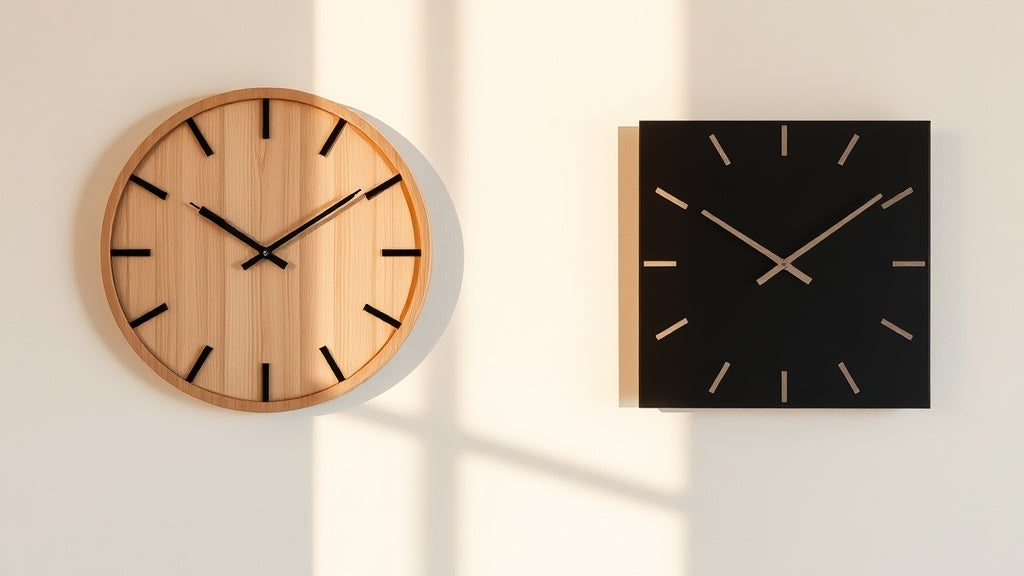
You've found the perfect wall. The paint color is right, the furniture finally clicks, and now there's this one empty space staring back at you. A clock would work perfectly there. But then comes the question nobody warns you about: round wall clock vs square wall clock, does the shape actually matter, or is it just a matter of taste?
It matters more than you'd think. Shape is one of those design decisions that works quietly in the background, either reinforcing the feeling of a room or subtly fighting against it. Get it right and the clock just belongs. Get it wrong and you'll spend months wondering why the space feels slightly off.
Here's what genuinely works, room by room, style by style.
Key takeaways
- Round clocks soften angular rooms and suit organic, Scandinavian, and mid-century styles naturally.
- Square and rectangular clocks reinforce structure; they're built for industrial, modern, and grid-based layouts.
- Wall shape, furniture lines, and existing decor all influence which silhouette reads best.
- Size matters as much as shape: a 12-inch round clock and a 60 cm round clock play completely different roles in a room.
- Neither shape is universally better. The right answer depends on the specific wall and the specific room.
Why Clock Shape Is a Design Decision, Not Just a Preference
Most people shop for clocks the way they shop for cushions: they find something they like and hope it works. But shape carries visual weight. A circle on a wall creates movement; the eye naturally follows a curve, which generates a sense of flow and softness. A square or rectangle stops the eye. It anchors. It aligns.
Interior designers talk about "visual tension" a lot, and clock shape is one of the simplest ways to either create it or release it. A round wall clock on a wall full of sharp-edged frames, shelves, and furniture introduces a single organic break that keeps the room from feeling too rigid. A square clock in the same spot would almost disappear into the geometry, adding bulk without adding interest.
The reverse is equally true. Put a round clock in a room that's already soft, lots of curved furniture, rounded rugs, organic shapes, and it can read as redundant. A square clock there would bring welcome contrast. This is the core tension at the heart of the round wall clock vs square wall clock debate: neither shape wins in isolation. Context is everything.

Where Round Wall Clocks Genuinely Shine
Round clocks are the default choice for a reason: they're versatile, they scale well, and they carry centuries of visual familiarity. A circle on a wall reads immediately as a clock, which means you can push the design of the face, the frame, and the finish much further before it starts to feel strange.
Living rooms with eclectic or layered decor
When a living room is mixing textures, linen sofas, wooden shelves, metal accents, woven baskets, a round clock acts as a visual mediator. It doesn't compete with any one element because its shape doesn't mirror any of them directly. Customers who've been layering collected pieces over years consistently land on round clocks for this reason. The shape holds its own without dominating.
Scandinavian and minimalist interiors
Nordic design principles are built on organic shapes borrowed from nature. Circles are everywhere: pendant lights, mirrors, cutting boards used as decor. A round wall clock slots into that language fluently. A Scandinavian wall clock in natural wood or matte black on a white wall is one of the cleanest design moves in this style. It's not trying to be clever; it's just right.
Bedrooms and reading nooks
Round shapes are associated psychologically with comfort and rest. In spaces designed for unwinding, that matters. A circle above a bed headboard or beside a reading chair reinforces the softness already built into upholstered furniture, rounded lamps, and plush textiles. It contributes to the mood without you consciously noticing it.
Kitchens with vintage or farmhouse aesthetics
The classic café-style round clock is practically a visual shorthand for a warm, lived-in kitchen. The round silhouette echoes plates, bowls, and the general roundness of kitchen objects. In a farmhouse or cottage kitchen with open shelving and ceramic pieces, a round clock anchors the wall without fighting the other objects for attention.
Elena's pick
Black Nordic Wooden Wall Clock - Scandinavian Bamboo Design
If you've been building a Scandinavian or minimalist room and wondering why the wall still feels unfinished, this is likely the missing piece. A round bamboo face with clean black hands: exactly the shape and material language the style calls for. Bamboo brings warmth without weight, and the matte black hands read sharply against the natural grain. It doesn't shout; it completes.
67.00 USD
See the product →Where Square and Rectangular Clocks Do the Heavy Lifting
Square clocks get underestimated. People default to round because it's familiar, and square ends up being treated like a quirky alternative. That's a mistake. In the right rooms, a square or rectangular clock is the stronger choice, not just stylistically different, but genuinely better suited to the space.
Industrial and urban loft spaces
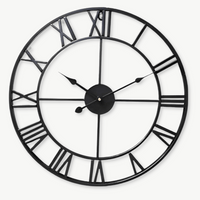
Industrial interiors are built on geometry: exposed brick in rectangular patterns, metal shelving on grid systems, square windowpanes, angular furniture. A round clock here can feel like an intruder, a soft shape in a room that's committed to hard lines. A square or rectangular clock, particularly in metal or with a raw, utilitarian finish, reads as part of the room's DNA. It belongs. An industrial wall clock with a bold square or rectangular case reinforces every other design decision already made in the space.
Home offices and workspaces
A home office is a room organized around function. Desks are rectangular, monitors are rectangular, bookshelves run in vertical and horizontal lines. A square clock on the wall behind a desk aligns with that structure; it looks intentional. It signals precision. Round clocks can work in a home office too, but they tend to read more decorative there, which isn't always the right note for a space meant to feel focused.
Modern and contemporary living rooms with clean architecture
In a room with flat-front cabinetry, linear sofas, and geometric artwork, a square clock can feel like it was designed alongside the furniture rather than added afterward. The parallel lines between a square clock face and the architecture around it create cohesion that's hard to achieve with a circle.

Did you know?
The round clock face became the dominant standard partly because of pocket watches: the circular movement mechanism was mechanically efficient, and when clocks moved to walls, the round shape came with them. Square clock cases existed in the 18th and 19th centuries as luxury objects, often in elaborate wooden or gilded frames, and were seen as more architectural than domestic, closer to a decorative panel than a timepiece.
The Wall Shape Rule That Most People Ignore
Here's something worth paying attention to: the shape of the wall space around the clock matters almost as much as the clock itself. Wide, horizontal wall sections, the kind you get above a long sofa or sideboard, tend to favor wide rectangular clocks or a horizontal grouping of round ones. Narrow vertical sections, like the wall between two doors or beside a window, suit square or portrait-oriented clocks more naturally.
A round clock on a very wide horizontal wall can look slightly adrift unless it's large enough (think 50-60 cm minimum) or surrounded by other wall objects. A square clock on that same wall immediately looks purposeful because its straight edges echo the horizontal line of the furniture below it.
The ceiling height plays into it too. High ceilings with vertical emphasis? A taller rectangular clock or a large round clock both work. Standard 8-foot ceilings in a compact room? A square clock that's proportioned for the space reads cleaner than an oversized round one that competes with everything else.
Shape Versus Style: When the Design Overrides the Geometry
There are clocks where the decorative treatment is so strong that the shape becomes secondary. A round steampunk gear wall clock with 3D wooden elements reads as sculptural; the roundness is almost incidental to its impact on a wall. Similarly, a highly ornate square clock in a maximalist interior might work purely because the detailing is so dominant that the shape is just its container.
The shape-first approach works best when the clock is relatively clean and graphic: a simple round face, a minimal square case, an uncluttered dial. As the clock becomes more elaborate, more texture, more depth, more visual detail, the shape becomes one element among many rather than the defining characteristic.
This is worth knowing because it changes how you shop. For a minimalist or Scandinavian room, shape is critical: buy the shape first, then the finish. For a maximalist or eclectic room, buy the piece that has the right energy, and let the shape be a secondary consideration.
That said, even in a maximalist space, scale still governs. A large statement piece earns its place by filling the wall with intention. Which brings us to a clock that does exactly that in a room that's already rich with texture and metallic accents.
Elena's pick
Gold Circle Design Wall Clock - 60 cm Metal Dial
When the design of a piece is bold enough to transcend its shape, this is what that looks like. At 60 cm, this gold metal dial has the scale to anchor a wide wall as a solo piece; no gallery arrangement needed, no supporting cast. The warm metallic finish works in contemporary rooms where brass or gold accents are already present, and in eclectic interiors where you need one strong focal point to hold everything together. Pure circle, pure presence.
209.00 USD
See the product →A Direct Comparison: Round vs Square by Room and Style
| Room / Style | Round Clock | Square / Rectangular Clock |
|---|---|---|
| Scandinavian / Nordic | Natural fit, echoes organic shapes, pendant lights, mirrors | Can work in very clean grid layouts; unusual but not wrong |
| Industrial / Loft | Creates intentional contrast against hard lines | Strongest choice, aligns with architectural geometry |
| Mid-Century Modern | Iconic, starburst round clocks defined the era | Works if the case has period-appropriate detailing |
| Farmhouse / Cottage | Classic, the café clock silhouette belongs here | Less common; works if it has a weathered or rustic finish |
| Contemporary / Minimalist | Strong when large and clean; small rounds can feel decorative | Very strong, geometric precision suits flat, architectural spaces |
| Home Office | Reads decorative; works if that's intentional | Reads functional and precise, suits the space's purpose |
| Bedroom | Softer, more restful, the better choice for most bedrooms | Fine if the room has strong architectural geometry |
| Eclectic / Maximalist | Shape is less critical, visual energy matters more | Same; choose by the design of the piece, not the shape |
The Size Factor: How Scale Changes Everything
Shape and size are inseparable in practice. A 10-inch round clock on a large wall reads as decoration, a small accent, not a statement. A 60 cm round clock on the same wall becomes a focal point. The shape is identical; the role in the room is completely different.
With square clocks, size shifts the reading even more dramatically. A small square clock (under 12 inches) can look like an afterthought, especially in rooms with a lot of competing visual elements. The same square form at 20 inches reads as deliberately architectural. The geometry of a square is unforgiving at small scales; it needs room to breathe and mass to carry.
A practical guideline: measure the wall space first, then identify the size, then choose the shape. Most people do it backwards; they fall for a clock they like, buy it, and then struggle to find the right placement. Starting with the wall gives you a much cleaner filter for making the shape decision.

For loft and industrial spaces where you've already committed to a geometry-forward aesthetic, a round clock that leans into the style's raw energy can actually reconcile the shape debate entirely. The finish does the heavy lifting, and the circle becomes a welcome moment of relief against all those hard lines.
Elena's pick
Industrial Copper Red Wall Clock - Metal Quartz Silent
Here's the proof that a round clock can thrive in an industrial or urban loft space: it just needs the right finish. The copper red metal casing is raw enough to belong alongside exposed brick and concrete, while the silent quartz movement means you're not trading aesthetics for noise. Works equally well in a factory-style open-plan kitchen or a moody studio apartment where you want one strong metallic accent on the wall.
From 105.00 USD
See the product →When Neither Shape Works, and What to Try Instead
Some walls genuinely don't suit either a clean round or a clean square. An arched alcove, a room with very pronounced diagonal architectural lines, or a space already crowded with strong geometric decor can make both shapes feel forced.
In those cases, the answer is usually to look at clocks that are neither strictly one nor the other: oval silhouettes, hexagonal cases, clocks with sculptural frames that extend beyond the face, or pieces where the decorative elements blur the underlying shape entirely. The Spherical Rings Metal Wall Clock, for example, creates a circular impression through its orbital ring structure rather than a solid disc, which gives it visual interest that a plain round face wouldn't achieve on the same wall.
The broader wall clock collection covers shapes well beyond the round/square binary, and it's worth browsing with your specific wall in mind rather than a shape preference in the abstract.
"A clock is the one piece of decor that every visitor in your home will look at directly and on purpose. The shape is the first thing they register, even before the time."
Interior styling principle, often cited in European design school curricula
Making the Final Call: A Shape Decision That Sticks
The round wall clock vs square wall clock question doesn't have a universal answer, and anyone who tells you otherwise is selling you a formula. What works is specific: specific wall, specific room, specific decor already in place.
Round clocks are the safer choice for most residential rooms; they're more forgiving, they fit more styles, and their visual familiarity means they rarely feel wrong even when they're not quite perfect. Square and rectangular clocks are the stronger choice when the room has committed geometry, when you want something that reads as intentional design rather than decoration, or when the workspace demands a certain visual precision.
The most important thing? Don't treat the clock as an afterthought. It goes on the wall permanently, it gets looked at dozens of times a day, and it says something real about how you think about the space. That's worth the extra ten minutes of thinking before you buy.
Frequently asked questions
Are round wall clocks more popular than square ones?+
Round clocks outsell square ones across most home decor categories, largely because the round format has the longest design history and fits the widest range of interior styles. That said, square and rectangular clocks are growing in popularity as industrial, modern, and workspace-focused interiors become more common. Popularity is worth knowing, but it shouldn't override what actually works for your specific room.
Can a square clock work in a living room?+
Absolutely. A square clock in a living room works best when the room has strong architectural lines, geometric furniture, or a contemporary or industrial aesthetic. It also works well as a deliberate contrast piece in an otherwise soft, organic room, though in that case, the square shape needs to be intentional enough to read as a design choice rather than a mismatch. Pair it with angular frames or structured shelving to tie it into the room's geometry.
What size round wall clock should I choose for a large wall?+
For a large wall (wider than 6 feet), a round clock should be at least 50 cm (roughly 20 inches) in diameter to hold visual weight on its own. Smaller round clocks on large walls tend to look like accessories rather than focal points. If you prefer a smaller clock, consider flanking it with two or three framed prints or mirrors to create a wall composition; the clock then becomes part of a group rather than a solo piece that has to carry the whole wall.
Does clock shape affect how easy the time is to read?+
The case shape (round vs square) has minimal impact on readability. What matters is the dial design: the size and contrast of the numerals or markers, the length of the hands, and the distance from which you'll typically read the clock. A large, clean round clock and a large, clean square clock are equally readable if the dial is well-designed. Smaller clocks in either shape with busy, decorative faces can be harder to read at a glance.
Which clock shape works better in a kitchen?+
Kitchens are one of the few rooms where round clocks have a clear advantage for most styles. The round format echoes plates, bowls, and cooking vessels, creating visual consistency on the wall. It also carries the vintage café association that works well in farmhouse and country kitchens. A square kitchen clock can work in a very modern, flat-front kitchen where the cabinetry is entirely geometric, but in most kitchens, round is the more natural fit.
Can I mix round and square clocks in one room?+
You can, though it's rarely necessary and can easily tip into visual noise. The safer approach is to keep clocks as solo focal points rather than grouping different shapes together. If your room uses a gallery wall format and you're mixing frames, a single round clock among rectangular frames can read as a deliberate highlight, and that contrast is actually intentional design. The rule is: contrast with purpose, not contrast by accident.