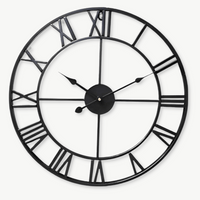


You've found a clock you love. The finish is right, the style works with your room, and you can already picture it on the wall. Then it arrives and... it's either swallowed by the space or so large it crowds everything around it. That feeling is more common than you'd think, and it almost always comes down to one thing: size.
Getting the right wall clock size for your room isn't complicated once you know what to measure and what numbers to aim for. If you've ever wondered what size wall clock do I need for my room, here's exactly what works, room by room.
Key takeaways
- For most rooms, a clock should cover roughly one-third of the wall width where it hangs.
- Living rooms typically call for 18-24 inches; bedrooms work best with 10-16 inches.
- Ceiling height changes everything: rooms taller than 9 ft can handle clocks up to 30+ inches.
- Always tape a paper template to the wall before you buy. Seriously, it takes five minutes.
- Viewing distance matters as much as wall size: add roughly 1 inch of diameter per foot of distance.
What Size Wall Clock Does Your Room Actually Need? The One Formula
The right wall clock size is your wall section's width multiplied by 30-40%: a 60-inch wall calls for an 18-24 inch clock, while viewing distance adds roughly 1 inch of diameter for every foot between you and the clock. Before diving into room-specific advice, here's the rule that interior designers actually use. Take the width (in inches) of the wall section where you plan to hang the clock. Aim for the clock diameter to be between 30% and 40% of that width.
So if you have a 60-inch wall segment above your sofa, you're looking at an 18-24 inch clock. A 90-inch wall calls for something in the 27-36 inch range. That ratio keeps things proportional without feeling forced.
Viewing distance adds a second layer. A good benchmark: for every foot of distance between the clock and where you'll typically sit or stand, add about 1 inch to the minimum diameter. Standing 8 feet away in your kitchen? A clock smaller than 8 inches will strain your eyes every single morning. This is the core of what size wall clock do I need for my room thinking: it's not just about the wall, it's about how you actually live in the space.

Did you know?
The standard wall clock diameter of 12 inches (30 cm) became an industry default in the mid-20th century based on factory production standards, not on what actually looks good in a room. That's why a 12-inch clock is often the least satisfying choice: it's sized for manufacturing convenience, not your walls.
Living Room: Go Bigger Than You Think
Living rooms need a clock diameter of 18-24 inches at standard ceiling heights, and 24-30 inches in open-plan or taller spaces, because furniture, art, and windows all compete for visual attention and a smaller clock simply disappears. The living room is where most people undersize their clock. You walk in, you see a 14-inch clock, and it looks fine in isolation. Then your eye catches the sofa below it, the 10-foot ceiling above, and suddenly the clock looks like a button on a duvet. Living rooms have visual competition: furniture, art, windows. A clock needs real presence to register.
For a standard living room with 8-9 ft ceilings, aim for 18-24 inches. If your ceilings push past 10 feet, or if you have an open-plan space, 24-30 inches isn't excessive at all. Above a fireplace mantle, 20-30 inches works well because the mantle itself frames the space and amplifies the visual weight.
One thing that catches people off guard: the clock's visual footprint. An open-frame or skeletal metal clock with cut-out details looks lighter than a solid-dial clock of the same diameter. That means you can sometimes go 2-4 inches larger with an open design without it feeling heavy. Browse the full wall clock collection to compare both styles side by side.

Elena's pick
Large Roman Numeral Wall Clock - Metal, Silent Quartz
Built for living rooms that need real scale, the Roman numeral dial reads clearly from across the room without shouting. The silent quartz movement means no ticking to distract from conversation.
219.00 USD
See the product →Bedroom: The Case for Restraint
Bedroom clock sizing calls for 10-16 inches in most master bedrooms, keeping the scale calm and personal while staying readable from 6-12 feet away in bed, bigger isn't better here. Bedrooms work differently. You're not trying to anchor a social space; you're trying to create something that feels calm, personal, considered. A clock in the bedroom is usually viewed from bed, which puts you anywhere from 6 to 12 feet away depending on the room layout.
For most master bedrooms, 10-16 inches hits the sweet spot. A 12-inch clock above a nightstand, or a 14-16 inch piece centered above the bed on a medium-sized wall, gives you easy readability without dominating the room. Guest bedrooms and smaller bedrooms are even more forgiving: 8-12 inches is plenty.
Style plays a role here too. Minimalist Scandinavian-style wall clocks with clean dials and thin hands read clearly at distance even at smaller diameters, because there's no visual noise to work through. A heavily decorated vintage clock with Roman numerals and ornate hands might need to be 2-3 inches larger to read just as clearly from the same distance. And if a ticking sound is something that keeps you up at night, look for silent quartz movements; they're genuinely worth it in a bedroom context.

Elena's pick
Black Nordic Wooden Wall Clock - Scandinavian Bamboo Design
Its clean Scandinavian bamboo dial reads perfectly from across a bedroom without demanding your full attention. Calm, clear, and genuinely quiet, exactly what a bedroom needs.
67.00 USD
See the product →Kitchen: Readability Over Decoration
A kitchen clock needs to be 10-14 inches for most spaces, with a bold high-contrast dial that reads instantly at a glance from 6-10 feet away while your hands are full and something is on the stove. In a kitchen, a clock earns its keep through legibility. You're moving fast, your hands might be busy, and you need to catch the time at a glance from 6-10 feet away while something is on the stove. That's a functional brief, not just a decorative one.
A 10-14 inch clock handles most kitchen spaces well. If you're working with a large kitchen-diner that has high ceilings and an open layout, 16-18 inches gives you better readability from across the room. The common mistake in kitchens is going too small: a 6 or 8-inch clock on a large tiled wall above the range hood looks decorative but stops being functional the moment you actually need to read it quickly.

Bold, high-contrast dials are your friend in kitchens. A dark face with light hands, or a white face with thick black markers, reads faster than delicate thin-hand designs. Industrial wall clocks often nail this balance, the exposed metal aesthetic plus oversized numerals gives you both function and character in one piece.
Home Office and Study: Small Space, Big Impact
Home office clock sizing lands between 8-14 inches for most setups, positioned just above or beside your monitor at seated eye level so it tells the time without competing with your screen. Home offices are tricky because wall space is already crowded. You've got shelves, a monitor, maybe art or a corkboard. A clock in this context has to be big enough to see from your desk (typically 3-6 feet away) without fighting for attention with everything else.
8-14 inches is the right range for most home offices. If you're working in a dedicated room with clear wall space, you can push to 16 inches; it'll serve as both timekeeper and a bit of personality. If you're in a compact setup or a corner desk arrangement, keep it 10-12 inches and position it somewhere in your natural line of sight (just above or beside your monitor, roughly at seated eye level). A minimalist clock in an industrial or Scandinavian style tends to sit quietly in a work environment without pulling focus, which is exactly what you want when you're trying to concentrate.
Dining Room: The Forgotten Clock Space
A dining room wall clock works best at 14-20 inches, hung on the long wall above a sideboard where it reads clearly from the table at 6-10 feet and adds an intentional, considered touch to the space. Most people never think about clocking their dining room at all, which is exactly why a well-placed clock there can feel so considered and intentional. The dining room often has a long, generous wall, either behind the sideboard or opposite the windows, that suits a clock beautifully.
Think 14-20 inches for a standard dining room. The clock will be viewed from seated positions at the table (usually 6-10 feet away), so readability matters, but you also want something that holds its own aesthetically without competing with pendant lighting or artwork. A large decorative wall clock in a 20-inch diameter above a sideboard in a dining room is one of those styling moves that looks effortless but took thought.
Hallways, Entryways, and Staircases: Context Is Everything
Clock diameter in transitional spaces ranges from 8-12 inches in narrow hallways up to 20-30 inches on staircase walls, because the viewing distance and ceiling height shift dramatically from one space to the next. These transitional spaces are where sizing gets most unpredictable. Hallways can be narrow with high walls, making a small clock look lost; entryways can be grand double-height spaces or compact coat-rack corners. Staircases climb walls that are seen from different distances and angles.
Narrow hallways (under 5 feet wide): keep the clock to 8-12 inches and hang it at eye level so it reads as a purposeful detail rather than an attempt to fill space. Entryways with higher ceilings: 18-24 inches works well, especially if you're treating the clock as the main decorative statement. Your entryway clock is the first thing guests see; it sets the tone for everything inside. Staircase walls viewed from the bottom of the stairs: think 20-30 inches, because you're viewing from distance and at an angle that makes small pieces disappear entirely.

Room-by-Room Wall Clock Sizing Chart
This room-by-room clock sizing chart covers all standard spaces using 8-9 ft ceilings as the baseline; add 2-4 inches to any range if your ceilings exceed 10 ft. Here's a quick reference. These ranges assume standard 8-9 ft ceilings; add 2-4 inches for ceilings taller than 10 ft.
| Room | Recommended Diameter | Key Consideration |
|---|---|---|
| Living Room | 18-30 inches | Visual competition from furniture; go bigger than feels natural |
| Bedroom | 10-16 inches | Calm scale; prioritize style clarity over size |
| Kitchen | 10-18 inches | Legibility first; bold dials read faster at a glance |
| Home Office | 8-16 inches | Short viewing distance; don't let it compete with screens |
| Dining Room | 14-20 inches | Seated viewing angle; statement piece without overwhelming |
| Narrow Hallway | 8-12 inches | Limited width; eye-level placement matters most |
| Entryway | 16-24 inches | Often high ceilings; sets the tone for the whole home |
| Staircase Wall | 20-30 inches | Viewed from distance and angle; small clocks disappear entirely |
Four Things That Shift the Numbers
Four variables, ceiling height, wall color, clock design density, and surrounding furniture, can each push your ideal clock diameter several inches up or down from the chart's starting point. The chart above gives you a solid starting point, but four variables can push you toward the upper or lower end of any range.
Ceiling height. Every extra foot of ceiling height above 8 ft typically warrants going 2-4 inches larger on your clock diameter. A 10-foot ceiling in a bedroom doesn't change the room's footprint, but it changes the wall's visual proportions dramatically.
Wall color and finish. Dark walls absorb visual mass, which means a clock has to be slightly larger to register with the same presence it would on a white or pale wall. Light walls do the opposite: they amplify everything, so a clock on a bright white wall can sometimes go on the smaller end of the range and still look intentional.
Clock design density. An open-frame clock with a skeletal structure reads as lighter and smaller than its actual diameter. A solid dark dial with a heavy frame reads as larger. Factor this in: an open-frame 22-inch clock might feel closer to a solid 18-inch clock visually.
Surrounding furniture and decor. A clock hung above a large sectional sofa competes with a lot of horizontal visual mass. It needs to be larger to hold the relationship. A clock hung alone on a quiet wall can be smaller because nothing around it dilutes its presence. Explore large wall clocks if your furniture leans toward oversized pieces.

Elena's pick
Spherical Rings Metal Wall Clock - 20 in Retro Design
At 20 inches with an open-ring frame, this one reads as larger than it measures, perfect for living rooms or dining spaces where you want presence without a solid heavy dial.
175.00 USD
See the product →How to Test Your Size Before You Commit
The paper template trick, cut your target diameter from kraft paper, tape it to the wall, and step back to your normal viewing position for 20 minutes, reliably confirms the right clock size before you spend a penny. The paper template trick deserves a little more detail because it genuinely saves people from returns. Grab a piece of kraft paper, cardboard, or tape a few sheets of newspaper together. Draw a circle to your target diameter, cut it out, and tape it to the wall at your intended hanging height.
Then step back to the distance you'd normally be in that room: your sofa position, your usual spot at the kitchen counter, your bed. Squint slightly (it reduces detail and lets you read the shape more like your brain registers it subconsciously). Ask yourself: does this feel too big, too small, or just right? Shift a size up or down by 4 inches and see how it changes.
Hanging height matters just as much as diameter. The general rule is to center the clock at eye level, roughly 57-60 inches from the floor. Above furniture (sofa, sideboard, headboard), aim for 6-8 inches of gap between the top of the furniture and the bottom of the clock. Too tight and it feels crowded; too much gap and the clock floats. See our guide on hanging a wall clock correctly for the full breakdown on placement, hooks, and anchoring.
"I kept going back and forth between the 20-inch and the 24-inch. Taped up both templates on a Saturday morning, the 24-inch was obviously right within two minutes."
Customer review, Factoclock, living room installation
When Bigger Is Simply Better: The Case for Statement Sizing
When a clock is meant to anchor the room as a focal point rather than simply keep time, sizing one step above the technically proportional range transforms it from background detail into a defining statement piece. There's a version of this question that goes beyond "what fits" and into "what do I actually want this clock to do in the room." For a lot of people, the clock isn't just timekeeping; it's the room's focal point. The thing your eye goes to when you walk in. The piece that anchors everything else.
For that role, you almost always need to size up. A clock that's technically proportional blends in. A clock that's one size larger than technically proportional becomes a statement. That's the logic behind luxury-format wall clocks over 24 inches: they don't just tell time, they define the wall.
The limit is balance. A clock so large it crowds nearby art or sits too close to ceiling moldings looks unintentional. The sweet spot is bold without cramped. Give your clock at least 12 inches of clear wall above it, and at least 8 inches on each side before the next object. Within those margins, push the size as large as you like.
Ready to find your perfect fit?
Now that you know exactly what size wall clock do I need for my room, browse the full collection and filter by diameter, style, and room type.
See our complete wall clock collection →FAQ
What is the most common wall clock size?+
The most commonly sold wall clock diameter is 12 inches (30 cm), largely because it became a manufacturing standard in the mid-20th century. For most modern homes, 12 inches is too small for living rooms and dining spaces, though it works well in smaller bedrooms and home offices at close viewing distances.
Can a wall clock be too big for a room?+
Yes, though it's rarer than people think. A clock becomes "too big" when it physically crowds nearby objects (less than 6-8 inches of clearance on sides or top), when it overwhelms the entire wall visually, or when the scale is so out of proportion it creates visual tension. This usually only happens with clocks above 30 inches in rooms smaller than 120 square feet.
How high should I hang a wall clock?+
The standard is to center the clock at eye level, around 57-60 inches from the floor. Above furniture such as a sofa, headboard, or sideboard, leave 6-8 inches between the top of the furniture and the bottom of the clock. On empty walls, eye level works universally well. Avoid hanging a clock so high that you have to tilt your head to read it.
Does clock style affect how big it should be?+
Significantly. Open-frame and skeletal clocks read visually lighter than their actual diameter suggests, so you can size up 2-4 inches compared to a solid-dial clock. Dark, heavy-framed dials visually amplify size. Ornate vintage clocks with decorative hands need extra diameter for readability at distance, while minimalist Scandinavian designs are highly legible even at smaller sizes.
What size clock works for a 10-foot ceiling?+
Add 2-4 inches to whatever the standard range is for that room type. A living room that would take an 18-24 inch clock at 8-foot ceilings can comfortably take a 22-30 inch clock with 10-foot ceilings. The extra vertical space changes how the wall is perceived, and a clock sized for lower ceilings will look undersized without being obviously wrong, which is the most visually unsatisfying outcome.
What if my wall is very small or narrow?+
Small walls call for intentional restraint. Apply the 30-40% rule strictly: on a 30-inch-wide alcove wall, an 8-12 inch clock is genuinely the right answer. Don't fight the space. A clock that fits well in a small area looks curated; one that's slightly too large looks like a mistake. In narrow hallways specifically, placement at exact eye level (57 inches to center) compensates for the compressed width and keeps the piece feeling deliberate.
Do silent (non-ticking) clocks make a difference beyond bedrooms?+
Absolutely, especially in home offices and reading rooms where any repetitive sound can break concentration. Silent quartz movements (sometimes called sweep movements) eliminate the tick entirely by advancing the second hand in a smooth continuous motion rather than a step-by-step click. If you're sensitive to ambient noise, it's worth checking the movement type before buying, regardless of which room the clock is going in.